Where to invest when the economic slowdown kicks in
14 December 2023 _ News

Economic slowdown
Last week was labour market data week, and the new information gave out different signals.
First, three main indicators pointed to the market’s apparent resilience:
- Unemployment fell from 3.9% to 3.7%;
- The workforce grew by 532,000, bringing workforce participation to 62.83%, a new post-pandemic high;
- Finally, the number of new jobs was 199,000 above the Consensus figure of 180,000.
Signs of a slowdown, however, came from the job vacancy figures, which were worse than expected. This number is very important for the Fed's future decisions, as a number of studies point out that, in order to get inflation back under control, the number of vacancies per unemployed person must be brought down to less than 1. This ratio was 2 a few months ago and is now 1.3, so it can be said that the Fed’s high rates are successfully reducing this ratio (graph below).
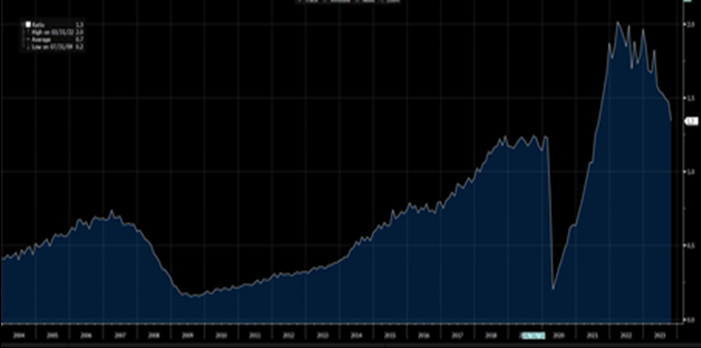
The question that arises is: was this labour data positive or negative? Our view is that the labour data gives evidence of a slowdown as yet unperceived by the market. There are two reasons for this outlook.
First off, the increase in new jobs included 30,000 in car production due to striking workers going back to work, so this statistic was an anomaly.
Secondly, this data cannot be considered reliable: the actual figures are smaller. For example, these figures in the following months were revised downwards by an average of 40,000 units in 2023 — a downward revision average never before recorded — bringing the annual revisions to 372,000 units. This gives the impression is that the labour market is shrinking faster than the consensus predicted.
How to invest
Given this economic slowdown scenario, investors should aim for value in equities and bonds.
This is the value in equities that translates into the over-weighting of leading sectors and companies that already have an economic slowdown priced in, and the under-weighting of market segments where expectations are a tad high and could therefore correct more in the event of a slowdown. The rebounding equity market in December is also heading in this direction, led by the companies that have fallen furthest behind.
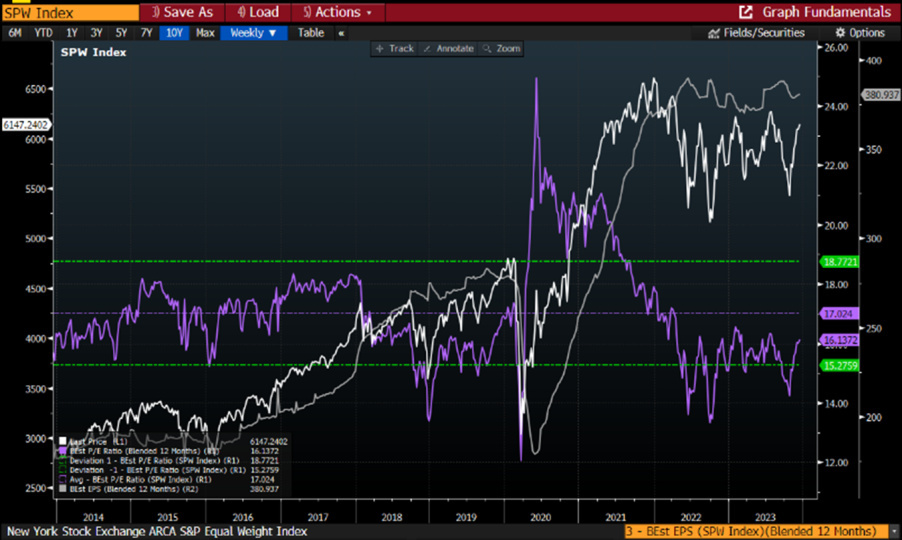
We start with the US equal-weight stock index, which continues to show a very attractive 16x valuation, at 20% off the S&P 500 (graph below).
Secondly, small US companies have already gone through a price recession, accompanied by an approximately -20% profit correction. By way of confirmation, about 60% of the companies in the Russel 2000 have corrected by at least 40% from their highs.
Thirdly, the European equities market continues to show very attractive valuations, with a price-to-earnings ratio at 12.7x, towards the lower end of its history and 15% off its average. In Europe, we also find several leading companies at a discount showing very attractive earnings growth profiles.
As regards sectors, we continue to favour defensive sectors: utilities-health care and consumer non-discretionaries, adding financials, where prices are already slowing sharply.
Value in bonds, on the other hand, translates into building extended-duration positions in government and investment grade bonds.
Looking at the history, we have entered a phase that lasts, on average, about a year to eighteen months, a time during which rates remain stable. This phase allows investors to exploit opportunities to lengthen duration, because it has always happened that some unforeseen event has cropped up, forcing central banks to cut rates to support economic growth.
In conclusion, to deal with this slowdown we believe it is crucial to focus on value in equities and bonds. Value will allow us to grasp great low-risk opportunities that focus on equities in sectors and companies with the slowdown already priced in and allow us to lengthen duration on the bond side.
The contents of this informative message are the result of the free interpretation, evaluation and appreciation of Pharus Asset Management SA and constitute simple food for thought.
Any information and data indicated have a purely informative purpose and do not in any way represent an investment advisory service: the resulting operational decisions are to be considered taken by the user in full autonomy and at his own exclusive risk.
Pharus Asset Management SA dedicates the utmost attention and precision to the information contained in this message; nevertheless, no liability shall be accepted for errors, omissions, inaccuracies or manipulations by third parties on what is materially processed capable of affecting the correctness of the information provided and the reliability of the same, as well as for any result obtained using the said information.
It is not permitted to copy, alter, distribute, publish or use these contents on other sites for commercial use without the specific authorization of Pharus Asset Management SA.