Yields are rising, and markets are getting nervous. What if that were actually good news?
17 September 2026 _ News

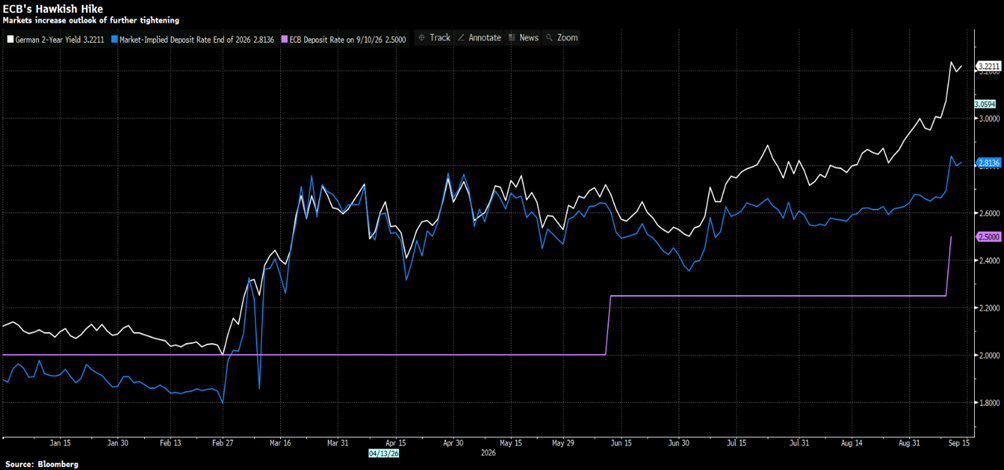
If you only looked at the headlines this week, you might have felt as though the sky was falling. The yield on the 10-year U.S. Treasury surged to nearly 5%, its highest level in almost three years. Oil broke above the 0-a-barrel mark as tensions between the United States and Iran flared up again. U.S. producer prices came in hot, rising 5.4% year over year. And the European Central Bank raised interest rates to 2.5%, with Christine Lagarde striking a distinctly hawkish tone.
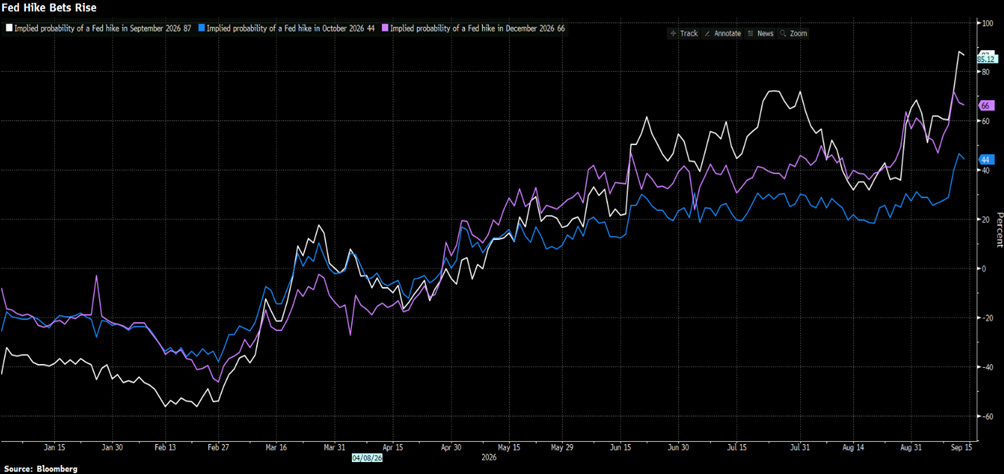
And on Wednesday, it will be the Federal Reserve’s turn, with the central bank potentially raising interest rates for the first time in quite some time.
In short, everything seems to be moving in the same unpleasant direction. And yet the question I want to ask you today is a different one — and perhaps the most important: what if the bond market is actually sending us a message that is the exact opposite of what it seems?
Let’s start with the facts, because this week’s picture looks like a perfect storm for interest rates. Oil climbed as high as 7 a barrel, driven by tensions in the Middle East and attacks on supply. More expensive oil fuels inflation and puts upward pressure on bond yields. In Europe, the ECB responded with the second rate hike of its cycle, bringing rates to 2.5%, and the market is now pricing in three more increases by the end of 2027. In the United States, Wednesday’s Fed decision hangs on the latest inflation data, with futures markets assigning an almost certain probability to a rate hike. It is the classic textbook scenario in which investors are instinctively tempted to sell.
But this is where the key argument of today’s episode comes in — and it turns that interpretation on its head. It comes from Campbell Harvey, a professor at Duke University and one of the most respected scholars of interest rates.
Harvey starts with a simple question: why are long-term yields rising? If they were rising because the market expected more inflation, that would be bad news. If they were rising because investors were becoming more worried about U.S. debt — now above trillion — that would be another bad sign.
But Harvey argues that neither explanation is supported by the data. Inflation expectations embedded in bond prices — what market participants call the “break-even” rate — have remained stable. And if sovereign risk were the concern, we would see it reflected in the risk premium investors demand. But that does not appear to be where the pressure is coming from.
So what is left? Real interest rates — in other words, yields adjusted for inflation.
Historically, real rates tend to rise when markets expect stronger economic growth. Put differently, yields may not be rising because the outlook is getting worse, but because the economy’s future looks more resilient than previously thought.
As Harvey puts it, perhaps the media narrative has it backwards: higher rates may actually be revealing expectations of stronger growth.
And that would be good news.
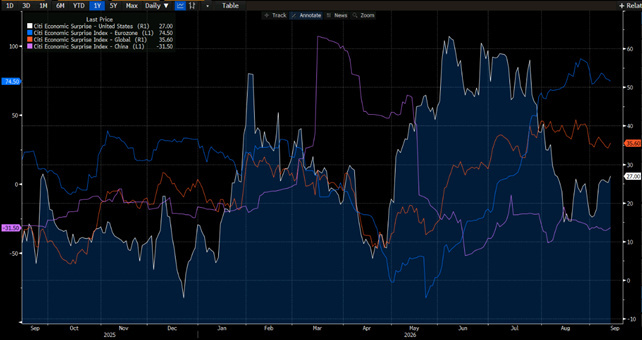
There is one more piece of the puzzle that makes this explanation even more tangible. Part of the rise in corporate bond yields comes from the huge amount of new debt companies are issuing to finance data centers and the broader infrastructure required for artificial intelligence.
More bond supply pushes prices down and yields up. But behind that debt is real investment, and investment is one of the main drivers of GDP.
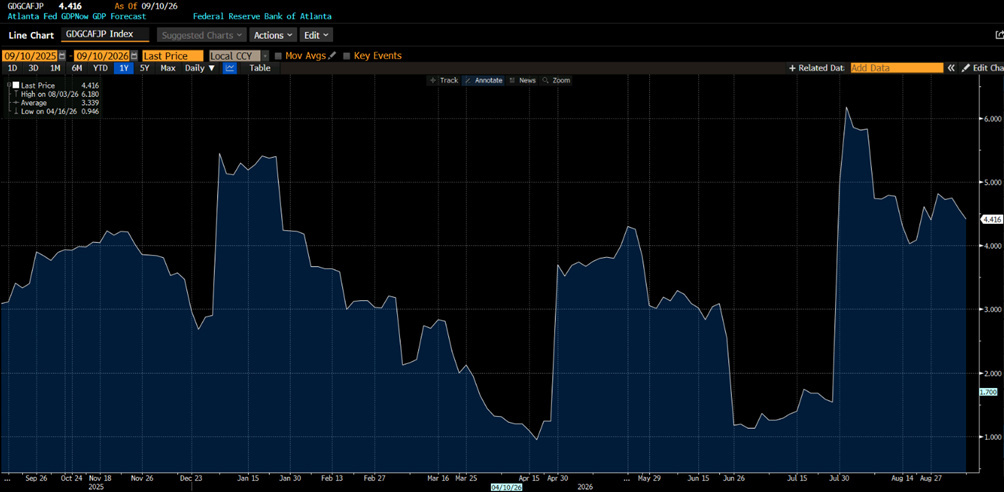
That helps explain why the Atlanta Fed’s model currently estimates annualized growth of 4.4% for the quarter — a pace consistent with an economy running at full speed. It is what economists sometimes describe as letting the economy “run hot”: the bond market has simply stopped betting on a slowdown and has started pricing in much stronger nominal growth.
And that is exactly the point emphasized by Yardeni as well, one of the Wall Street strategists who has read the markets particularly well in recent years. His view on yields remains clear: the 10-year Treasury is still trading within what he calls the “old normal” — the 4% to 5% range that he considers perfectly consistent with a healthy economy.
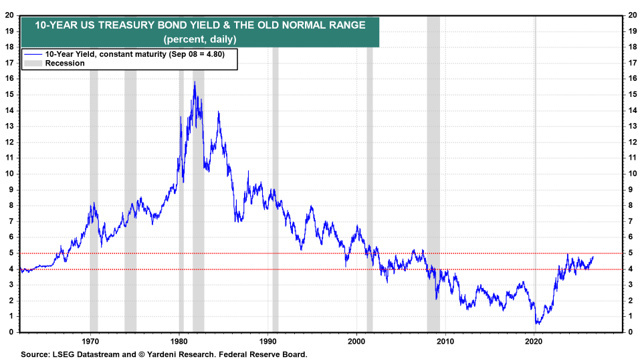
Even if the 10-year yield were to rise as high as 5%, Yardeni would see that level as more attractive than alarming — in other words, a good time to buy bonds rather than run away from them. He also adds another detail: Treasury Secretary Bessent has shown that he is prepared to defend that threshold, through bond buybacks and support for the yen. This is what has been dubbed the “Bessent put” — a kind of implicit safety net that reduces the chances of yields breaking decisively above 5%.
A word of caution, though: for now, this is still more about words than action. The billion in announced buybacks is little more than a rounding error in a market worth nearly trillion. But the message to investors is clear. If that is the interpretation of interest rates, we then come to the most optimistic part of the week: earnings.
Yardeni gives it a memorable acronym, FEMO, which stands for “Fabulous Earnings Momentum.” And the numbers seem to support his case. In the second quarter, earnings for the S&P 500 rose by an extraordinary 50%.
It is true that part of that increase was driven by accounting gains, as we discussed in recent weeks. But even after stripping those out, underlying earnings growth still comes in at around 25%.
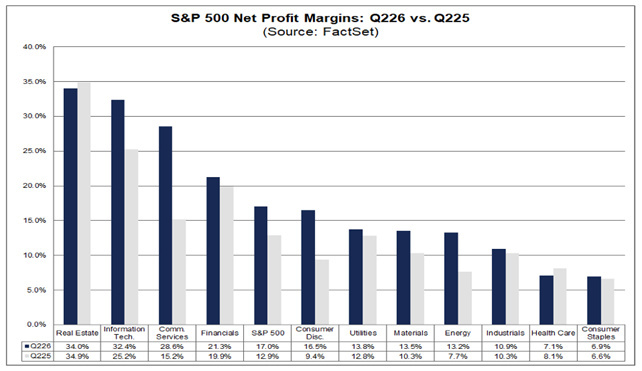
For the third and fourth quarters, analysts are currently forecasting earnings growth of 23% and 28%, respectively, with estimates still being revised higher.
But the point I want to highlight is a different one — and it is the most counterintuitive: while earnings are surging, valuation multiples are actually compressing.
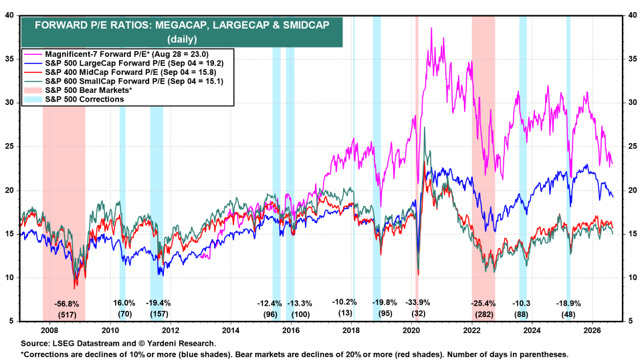
In other words, investors are paying less, not more, for each dollar of growth. That is the exact opposite of the 1999 bubble. Back then there was euphoria; today there is skepticism.
And, crucially for an asset manager, the strength is broad-based. Nearly 90% of companies in the index are seeing positive revisions to both revenues and earnings, and since the start of the year the basket of the 493 companies outside the major technology giants has returned 15%, compared with just 5% for the “Magnificent Seven.”
The market is broadening out, just as we had hoped. That said, our job requires balance, and there are still some clouds we should not ignore. The biggest one, in my view, concerns profit margins, which are currently at record highs, just above 17%.
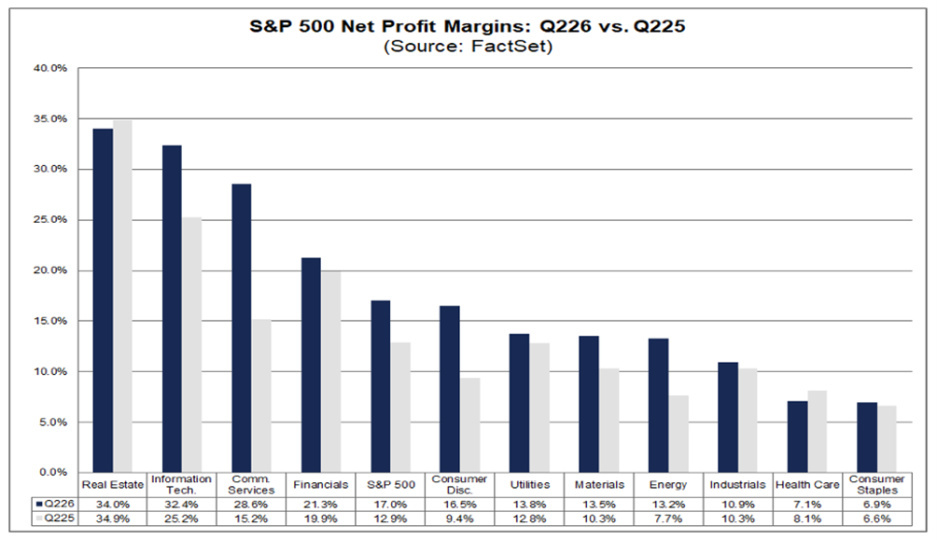
The market’s apparent attractiveness rests on one key assumption: that U.S. companies will be able to maintain the most profitable margin structure we have ever seen. If those margins were to normalize back toward 14%, much of that apparent discount would disappear. It is the old principle of mean reversion: sooner or later, markets tend to move back toward their averages.
And then there is the seasonal factor. September has historically been the most difficult month for equities, although it is worth remembering that this weakness often creates the conditions for the year-end rebound that frequently begins in October.
The bottom line is that this week has reminded us of an important lesson: we should not confuse noise with signal.
The noise is the fear of rising rates and surging oil prices. The signal, if we read it correctly, is a strong economy and rapidly expanding earnings, while valuations are actually becoming less stretched.
For investors, this suggests three things. First, do not let bond-market panic push you into selling. If rates are rising because of stronger growth rather than economic collapse, then any correction is more likely to be an opportunity than a catastrophe.
Second, continue to focus on the broadening of the market, gradually shifting attention toward the sectors and companies that are capturing real earnings growth. Third, as I always say, keep a reserve of liquidity. Ultimately, the real message from markets this week is that rising rates and surging earnings can tell the same story: an economy growing faster than expected.
The investor’s job is not to predict the Federal Reserve’s next move on Wednesday. It is to understand whether the strength beneath the surface is real — and this time, the numbers suggest that, to a large extent, it is.
The contents of this informative message are the result of the free interpretation, evaluation and appreciation of Pharus Asset Management SA and constitute simple food for thought.
Any information and data indicated have a purely informative purpose and do not in any way represent an investment advisory service: the resulting operational decisions are to be considered taken by the user in full autonomy and at his own exclusive risk.
Pharus Asset Management SA dedicates the utmost attention and precision to the information contained in this message; nevertheless, no liability shall be accepted for errors, omissions, inaccuracies or manipulations by third parties on what is materially processed capable of affecting the correctness of the information provided and the reliability of the same, as well as for any result obtained using the said information.
It is not permitted to copy, alter, distribute, publish or use these contents on other sites for commercial use without the specific authorization of Pharus Asset Management SA.