The Treasury is buying back Its own bonds: who really controls long-term rates?
27 August 2026 _ News

On Wednesday, at the opening of Wall Street, the U.S. Treasury announced that it will double the size of the operations through which it buys back its own longer-dated securities in the market: from billion to billion per operation for Treasuries with maturities between 10 and 30 years, effective September 9. The 30-year yield fell by nine basis points to 5.19%, while the 10-year yield dropped by six basis points to 4.64%.
Let’s start with the facts. On Tuesday, the yield on the 30-year Treasury rose above 5.31%, its highest level since 2007, on the eve of the global financial crisis. And it did so while the probability of a September rate hike was falling to around 31%: long-term yields were rising even as expectations for the Fed were declining. When that happens, the long-term yield is no longer mainly telling us something about monetary policy. It is starting to reflect something else — concerns about fiscal deficits, expected inflation, and the amount of return investors now require to lend money to the United States for 30 years. The following day, Scott Bessent provided the response.
A buyback simply means that the Treasury repurchases securities it has already issued on the secondary market. But the Treasury cannot print money, so in order to buy back long-dated bonds it has to borrow elsewhere, typically at shorter maturities. In practice, it is swapping long-term debt for short-term debt.
The logic is similar to the approach adopted by the Federal Reserve in 2011 through Operation Twist — buying long-term securities, selling short-term securities and putting downward pressure on the far end of the yield curve — with one important difference: back then, it was the central bank doing it; today, it is the Treasury Department. In absolute terms, the amounts involved are still small. At the peak of its post-pandemic asset purchases, for example, the Federal Reserve was buying around 0 billion of securities per month. The message therefore matters more than the size of the intervention: the Treasury is closely watching the 30-year yield and does not want long-term borrowing costs to remain at these levels.
The effects of the announcement were also visible across other asset classes, although not all in the same direction. U.S. equities largely shrugged it off, closing up 0.21%. Gold posted its strongest daily gain in six months, climbing back toward ,500 an ounce, while the dollar suffered one of its worst sessions in recent months.
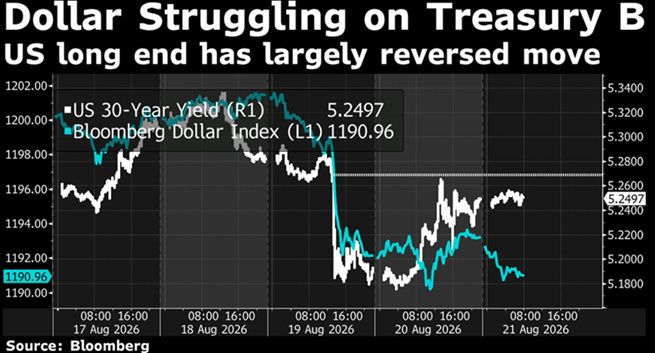
U.S. 30-year Treasury yield (white line, right-hand scale) and U.S. Dollar Index (light blue line, left-hand scale), from August 17 to August 21, 2026. Source: Bloomberg.
The chart shows the two variables hour by hour over the course of the week. On Wednesday, following the announcement, both Treasury yields and the dollar fell. But over the next two days, yields climbed back close to their previous levels, while the dollar remained weak. Put simply, the Treasury failed to bring interest rates down, but it did manage to weaken its own currency.
On Friday, Bessent said he was prepared to expand the buybacks and announced that the administration would soon unveil an initiative aimed at reducing borrowing costs. In other words, the first move was not enough, and another one is already needed. The objection circulating among market participants is straightforward: without action on public finances, buying back a few billion dollars’ worth of bonds does not solve the underlying problem. And the surrounding numbers explain why. Also on Wednesday, U.S. federal debt surpassed trillion for the first time.
Later that same Wednesday, the minutes of the Federal Reserve’s July meeting were released. At that meeting, rates had been left unchanged at between 3.50% and 3.75%, although three members had dissented, calling for an immediate rate increase. The minutes added two important details. First, the hawkish camp was broader than the vote itself suggested: several members had already been in favour of raising rates in July. Second, an even larger group believes that another increase may be necessary if disinflation fails to resume. So, on the same day, two institutions from the same country were pushing in opposite directions: the Treasury was trying to lower yields, while the central bank was preparing the ground to raise rates.
The question, then, is whether the U.S. economy can withstand what the Fed is considering. Walmart fell more than 9% — its worst session in over four years — after U.S. comparable sales rose 2.6%, versus the 3.8% expected, while revenue growth was the weakest in more than six years. The company pointed to consumers pulling back in response to higher gasoline prices.
This is not an isolated case. Payrolls fell by 23,000 in July, compared with expectations for an increase of around 83,000; retail sales disappointed; and the University of Michigan consumer sentiment index dropped to 51 from 55.2 in just one month, while one-year inflation expectations rose again to 4.3%. At the same time, Brent crude returned to around a barrel after Trump threatened an “economic war” against Iran. The same oil price that is keeping inflation expectations — and therefore long-term yields — elevated is also eroding consumers’ purchasing power. This is the squeeze facing the Fed: an economy cooling on the demand side, while inflation remains high on the cost side.
There is another obstacle making the Treasury’s task even more difficult. While the government is trying to buy back long-dated bonds, an entire sector is doing exactly the opposite. In recent months, hyperscalers and companies across the artificial-intelligence supply chain have begun issuing debt on a systematic basis.
Alphabet’s debt, for example, has risen from roughly billion to around 0 billion in twelve months. To finance itself, the company has issued debt this year in U.S. dollars, yen, euros, Swiss francs, Canadian dollars and sterling — including a 100-year bond — and on Wednesday it made its debut in the Australian market with three-, five-, ten- and twenty-year tranches. The most recent case is Broadcom, which according to reports is seeking more than billion to finance the supply of custom chips to customers including Anthropic, partly through private credit.
The remaining question is how the market is pricing all this debt. CDS spreads on these companies — contracts used to insure against an issuer’s default — are rising, meaning that the cost of protecting against their failure is increasing. The move has been clear since the beginning of the summer. Over the same period, broader U.S. Investment Grade and High Yield CDS indices have remained relatively stable. The credit market as a whole remains calm, but investors have started demanding more from the companies financing the artificial-intelligence boom.
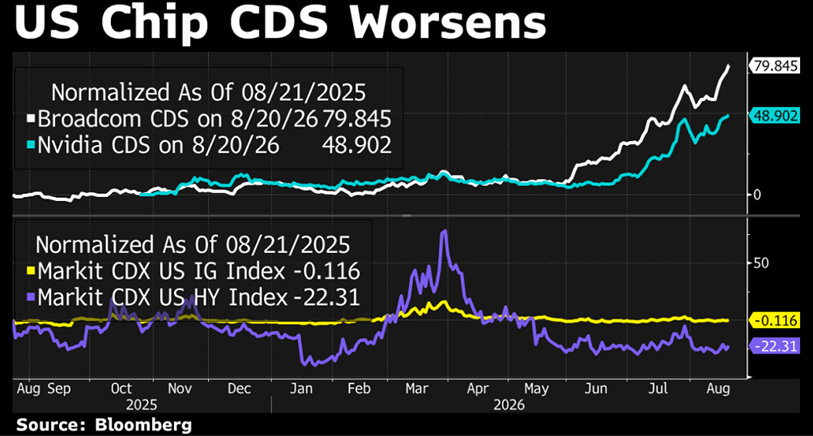
Broadcom CDS (white) and Nvidia CDS (light blue), with the CDX Investment Grade and High Yield indices below. Source: Bloomberg.
On the earnings front, however, the picture appears to be the opposite. The reporting season now drawing to a close is the strongest since 2021: with 88% of S&P 500 companies having reported, earnings are up 50.4% year over year, compared with the 23.1% growth expected at the end of June. An extraordinary figure.
But excluding just two companies — Alphabet and Amazon — that growth rate falls to 32%. The reason is that Alphabet’s reported earnings include a billion gain from unrealized revaluations of equity investments, while Amazon’s include a .4 billion gain linked to its investment in Anthropic.
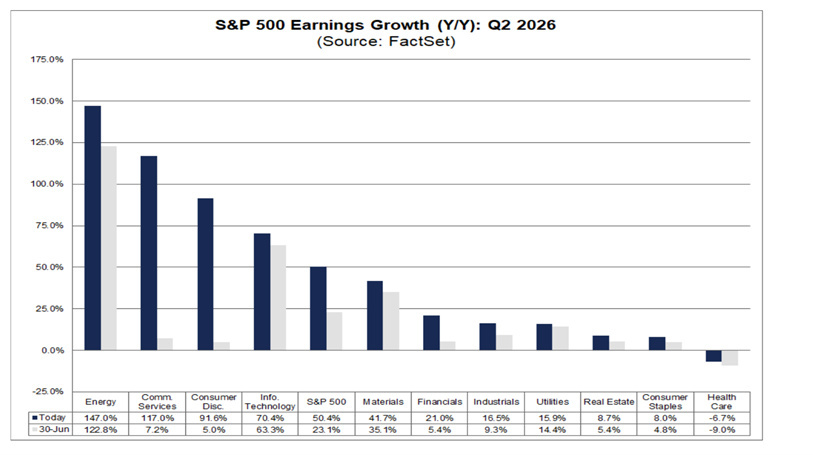
S&P 500 earnings growth by sector, second quarter of 2026: current results (blue) versus estimates as of June 30 (grey). Source: FactSet.
In Communication Services — Alphabet’s sector — earnings growth rises from the 7.2% expected to 117% actually reported; in Consumer Discretionary, where Amazon sits, from 5% to 91.6%. In Energy, Technology and Materials, by contrast, the two bars remain close because analysts already had a fairly accurate idea of what to expect. These are legitimate accounting profits, but they are not cash: they reflect valuations assigned to private companies that are themselves increasingly financing their growth through debt.
Everything we have described will be tested in the coming days. On Wednesday, three key events arrive together: July PCE inflation — the Fed’s preferred inflation gauge — the second estimate of second-quarter GDP and, after the market close, Nvidia’s quarterly results, which remain one of the clearest gauges of artificial-intelligence spending. Then, toward the end of the week, attention will turn to the Jackson Hole symposium, where Kevin Warsh is due to speak for the first time as Fed Chair. The official theme of the conference is innovation in payments, but the real questions are different: whether the rate-hiking cycle is merely on hold or truly over, and how the central bank views the fact that the Treasury has started intervening more directly in the long end of the yield curve.
In short, this week the U.S. Treasury tried to do something that normally falls within the central bank’s sphere, and the result was a weaker dollar while long-term yields moved back close to where they had started. Beneath the surface is an economy caught between opposing forces: a Fed whose minutes suggest that further tightening remains on the table, a consumer that is beginning to weaken, and a corporate sector that continues to demand more funding from the debt market.
This is not a crisis scenario. But it is a sign that, at the long end of the curve, pricing is no longer purely technical: it has become political as well. For investors, the task is therefore to remain disciplined and avoid being pulled too far by the prevailing narrative of the moment.
The contents of this informative message are the result of the free interpretation, evaluation and appreciation of Pharus Asset Management SA and constitute simple food for thought.
Any information and data indicated have a purely informative purpose and do not in any way represent an investment advisory service: the resulting operational decisions are to be considered taken by the user in full autonomy and at his own exclusive risk.
Pharus Asset Management SA dedicates the utmost attention and precision to the information contained in this message; nevertheless, no liability shall be accepted for errors, omissions, inaccuracies or manipulations by third parties on what is materially processed capable of affecting the correctness of the information provided and the reliability of the same, as well as for any result obtained using the said information.
It is not permitted to copy, alter, distribute, publish or use these contents on other sites for commercial use without the specific authorization of Pharus Asset Management SA.