U.S. 10-year treasury yield at its highest since 2002: is it really time to sell stocks?
08 October 2026 _ News

We entered October and the final quarter of the year with a contradiction on the table. On the one hand, the yield on the U.S. 10-year Treasury reached 5.33%, its highest level in twenty-four years, since 2002 — a figure that would normally send shivers through equity markets.
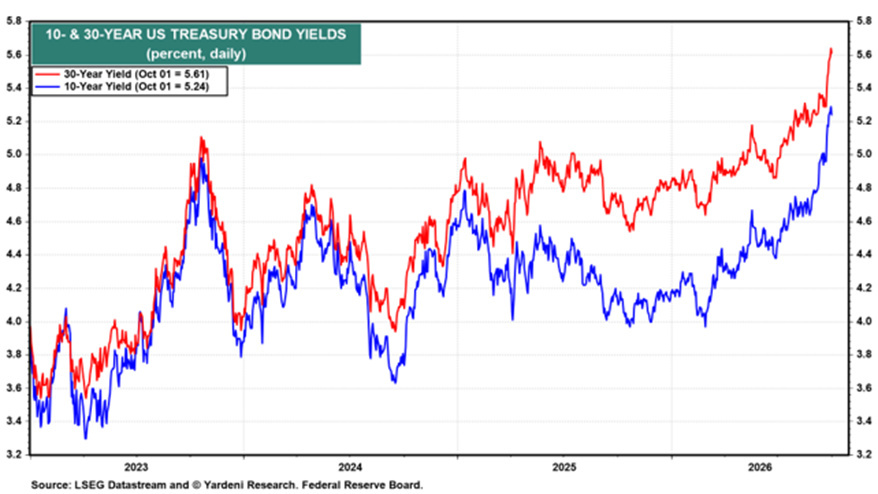
On the other hand, equity markets remain resilient and close to their all-time highs. So the question I want to start with is the simplest, but also the most important: why are interest rates rising so sharply, and what does this really mean for investors?
Let’s start with the “why.” We have already discussed the reason in previous podcast episodes, and it comes down to a word coined by U.S. analysts: “growthflation” — growth and inflation at the same time.
The U.S. economy remains strong, while inflation is still stuck at around 3%. The latest PCE reading — the Federal Reserve’s preferred measure of inflation — came in below expectations, sharply reducing the probability of another Fed rate hike in October.
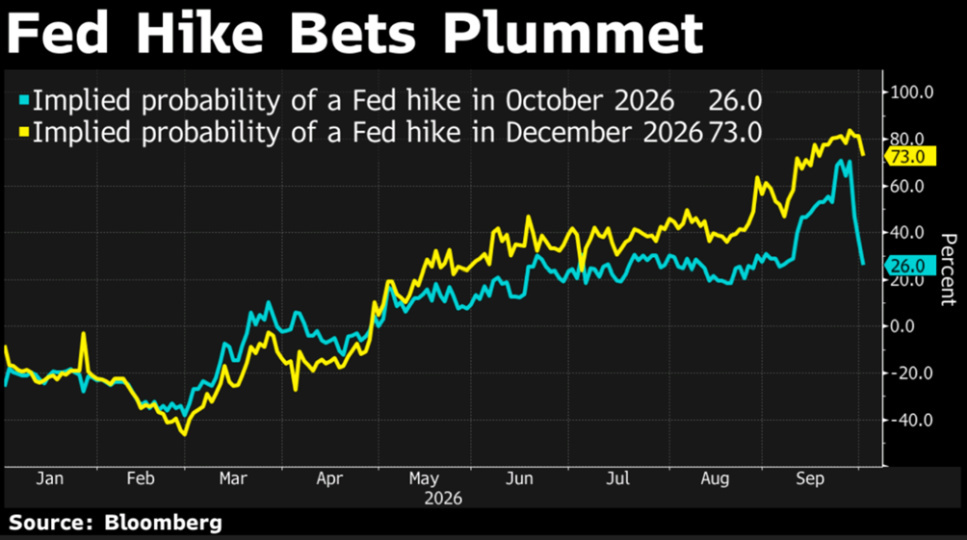
But much of that improvement does not come from a genuine cooling in inflation. Instead, it reflects changes in the statistical methods used to calculate it. Beneath the surface, underlying inflation remains sticky, and the prices of some goods are actually starting to rise again.
Put simply, the economy is strong and inflation is not giving way. It is the combination of these two forces that is pushing yields higher. At least for now, this is not panic over U.S. debt; it is the reflection of an economy growing at more than 5% in nominal terms.
Micron, one of the world’s leading memory-chip manufacturers, offered further evidence that this growth engine may still have plenty of room to run when it released its latest quarterly results.
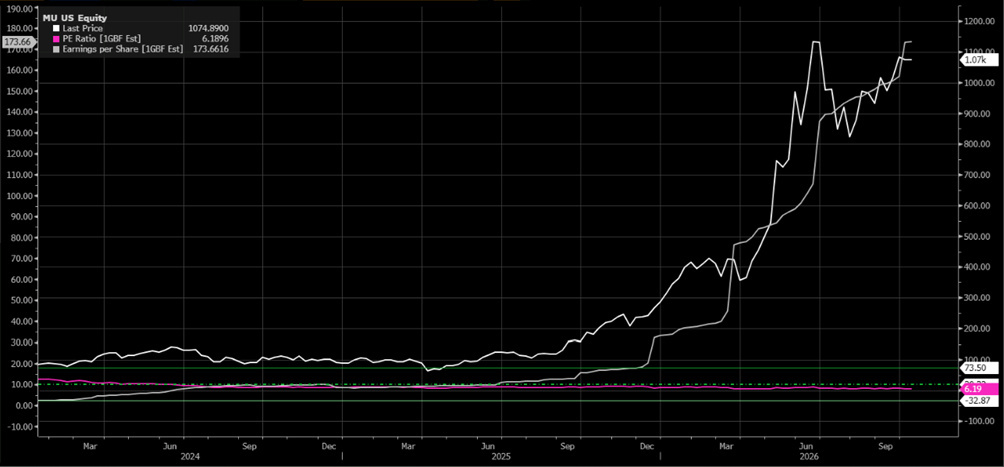
Its numbers were staggering: revenue up 379% year on year to a record high, margins at 87%, and guidance for the coming quarter well above expectations, with more than three quarters of next year’s production already sold in advance.
What is particularly striking is that, despite all of this, the stock was trading at a price-to-earnings ratio of just 7 times before the earnings release. The reason is that the market still treats memory-chip manufacturers as cyclical businesses, exposed not only to sharp upswings but also to structural downturns. It is a sign of how much skepticism remains, even as the cloud giants continue to increase infrastructure spending, which is estimated to exceed .2 trillion in 2027.
In short, the real economy is holding up, and the rise in interest rates reflects its strength more than its fragility.
But the key development of the week — and the reason high rates deserve our attention — is an almost historic shift. For more than a decade after the 2008 financial crisis, one acronym dominated: TINA, “There Is No Alternative.” It meant that with interest rates at zero and bonds offering virtually no return, equities were the only place to invest. Every market correction was something to buy, because there was simply nowhere else to put your money.
Now, as a growing number of strategists have pointed out, that world is over. TINA has effectively been replaced by TIGA: “There Is a Good Alternative.” Today, a U.S. government bond yields more than 5%, a high-quality corporate bond yields even more, and the real yield — meaning the return after inflation — is close to 3%, its highest level in almost eighteen years.
And this is not just a U.S. story. It is a global phenomenon.
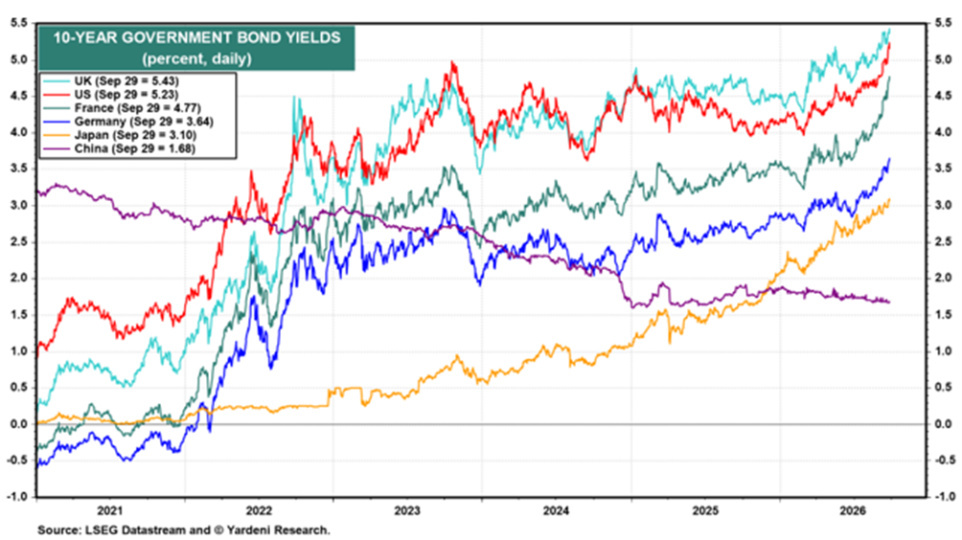
The consequence is striking, and it is today’s key point: on paper, the equity risk premium has virtually disappeared.
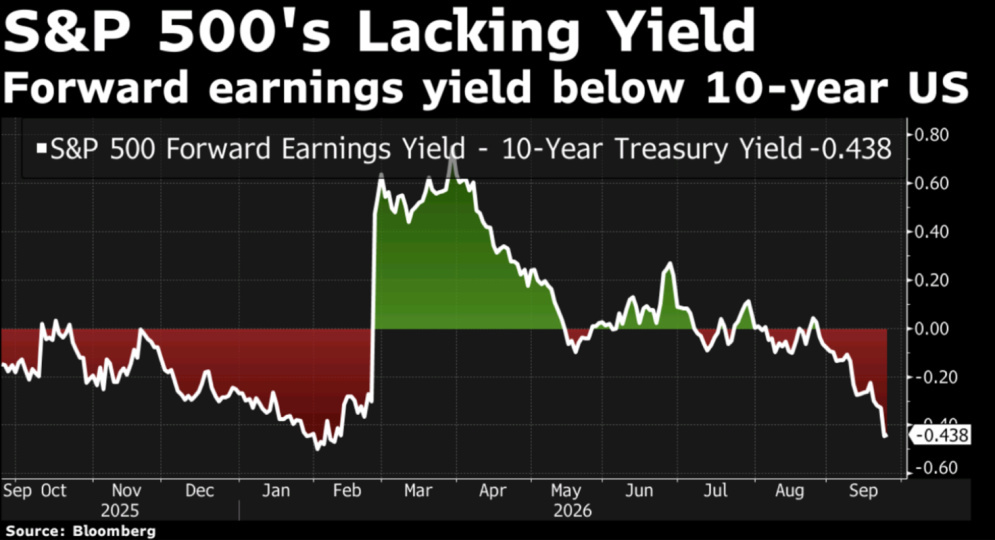
Let me explain. The equity risk premium is the additional return an investor should demand for taking on the risk of owning stocks rather than a safe bond. Today, the earnings yield on equities, at around 5.2%, is roughly in line with the yield on the U.S. 10-year Treasury, whereas in 2012 equities offered about six percentage points more.
Put that way, it might seem that bonds have become more attractive than stocks, and that investors should therefore sell equities and buy bonds. But that would be the wrong conclusion, because this is a static snapshot, and like any snapshot, it ignores movement.
A bond coupon is fixed. Corporate earnings, by contrast, can grow. And buying equities means buying exposure to that growth — something the bond market simply cannot offer. So that one-for-one comparison only holds “all else being equal,” meaning only if we assume earnings remain flat. If the earnings growth expected by analysts actually materializes, the upside potential for equities remains well above that 5.2% — provided, and this is the key uncertainty, that the growth really does come through. Because earnings growth is a promise, not a certainty like a bond coupon.
The message is not “get out of stocks and move into bonds.” It is that, for the first time in a generation, we have two asset classes that are both attractive.
On one side, bonds finally offer a generous and relatively secure real return. On the other, equities offer something bonds never can: participation in earnings growth. For fifteen years, investors effectively had only one leg to stand on: equities, because bonds offered almost no return. Today, we have two legs again. And that is exactly what makes diversification in balanced portfolios valuable once more.
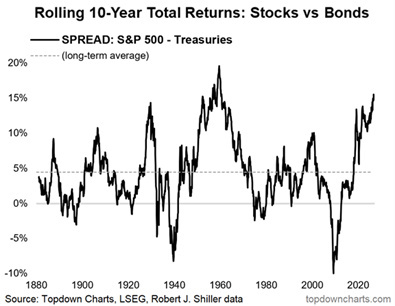
During a long bull market, diversification can seem pointless, almost like a drag on returns. It may look inefficient while everything is rising, but it becomes valuable the moment something goes wrong.
The difference today is that diversification no longer comes at the cost of giving up returns, because the second leg of the portfolio — bonds — is paying again. It is not a choice between two alternatives, but an opportunity to own both.
And one final point to put the equity side into the right perspective. Reassessing the role of bonds does not mean becoming defensive on equities. That might seem like the natural conclusion, but a Fidelity study suggests that history points in the opposite direction.
When interest rates start below the rate of nominal economic growth and the central bank responds with moderate rate hikes — exactly the situation we are in today — offensive sectors have historically led the market, not defensive ones.
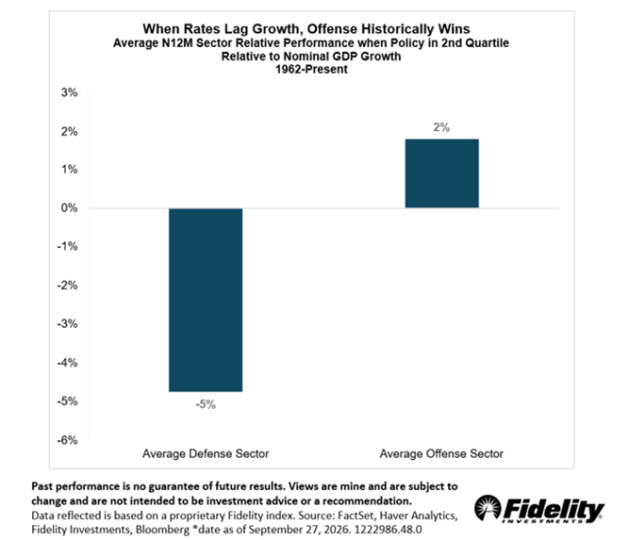
In these environments, technology has outperformed the broader market nearly 80% of the time, while defensive sectors have lagged.
The reason is the same one we have been repeating for weeks: rising interest rates often go hand in hand with improving growth expectations, and growth matters more than monetary policy.
So far, I have focused mainly on the long term, but it is worth saying a few words about the short term as well, because right now the calendar is on the market’s side.
Historically, the fourth quarter has been the strongest quarter of the year, delivering positive returns in more than 80% of cases, with an average gain of 4.2%.
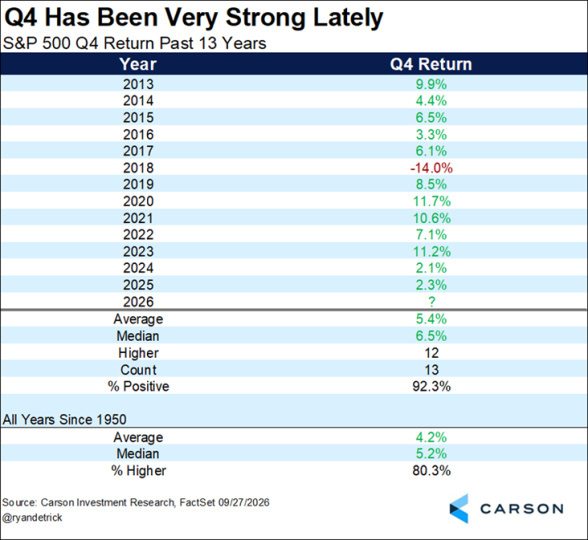
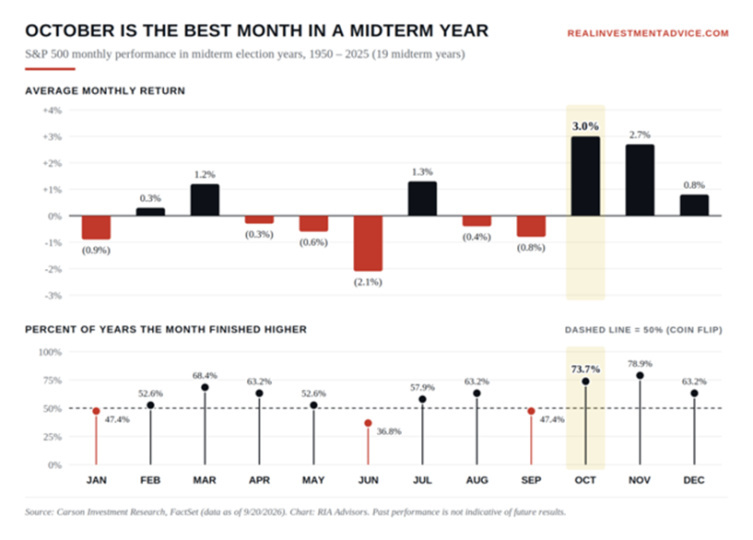
Moreover, in U.S. midterm election years like this one, October has been the strongest month of the year since 1950, with an average gain of around 3%.
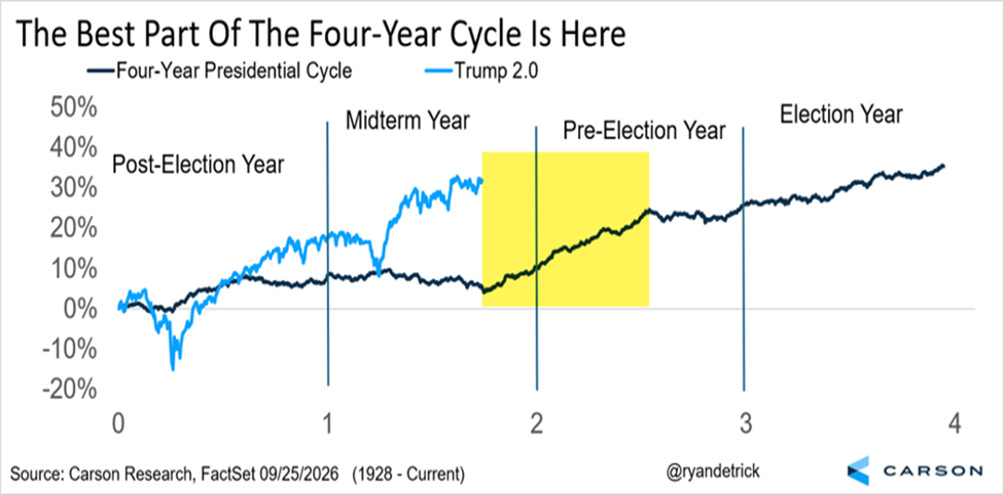
What’s more, we are entering what has historically been the strongest phase of the four-year U.S. presidential cycle.
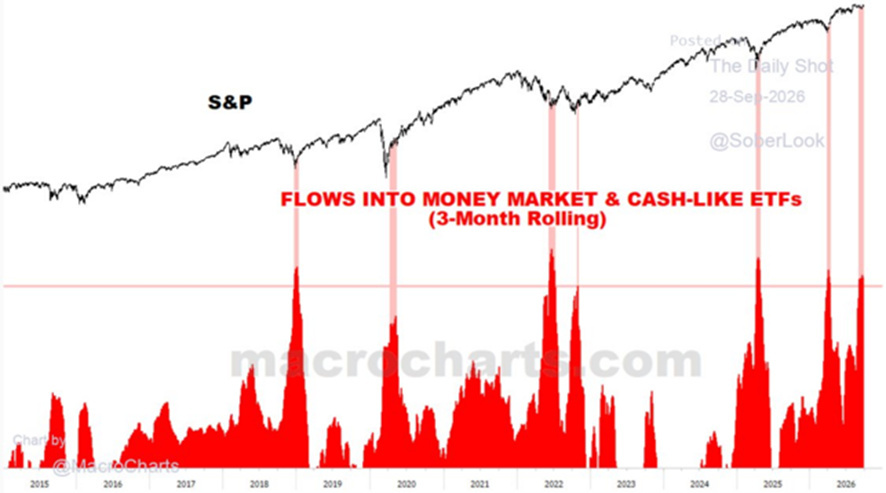
On top of that, investor sentiment is unusually gloomy, while a large amount of cash remains parked on the sidelines. From a contrarian perspective, these are often the kinds of signals that precede a rebound.
Of course, these are still statistics and should be treated for what they are: an indication of probability, not a certainty.
So, what should we take away from this week?
There is really just one key thing to do right now: follow the upcoming earnings season closely. It begins in the United States over the next few days, on October 13, with the major U.S. banks.
That is where the real test lies, because that is where we will see whether the extraordinary earnings trend can hold and continue. And that is exactly the point: as long as that trend remains intact, fear over higher interest rates becomes an opportunity rather than a reason to exit equities.
A 10-year Treasury yield at a twenty-four-year high may look intimidating, but as we have seen today, as long as it reflects a strong economy, it is not a death sentence for stocks. It is a sign of an economy that is still very much alive. In the end, the real news this week is that, after almost twenty years, investors once again have a genuine alternative: two asset classes that are both attractive. Bonds are finally offering meaningful yields again, while equities provide access to earnings growth. Knowing how to combine the two, while keeping a close eye on the earnings season ahead, is the task of a prudent investor.
The contents of this informative message are the result of the free interpretation, evaluation and appreciation of Pharus Asset Management SA and constitute simple food for thought.
Any information and data indicated have a purely informative purpose and do not in any way represent an investment advisory service: the resulting operational decisions are to be considered taken by the user in full autonomy and at his own exclusive risk.
Pharus Asset Management SA dedicates the utmost attention and precision to the information contained in this message; nevertheless, no liability shall be accepted for errors, omissions, inaccuracies or manipulations by third parties on what is materially processed capable of affecting the correctness of the information provided and the reliability of the same, as well as for any result obtained using the said information.
It is not permitted to copy, alter, distribute, publish or use these contents on other sites for commercial use without the specific authorization of Pharus Asset Management SA.