When the Stock Market supports the economy (and not the other way around)
01 October 2026 _ News

September was supposed to be the month of disaster. For weeks, that was all anyone talked about: negative seasonality, rising rates, oil above 0 a barrel, and the Fed hiking rates for the first time in three years. Everyone was bracing for the worst. And yet here we are, at the end of the month, with the S&P 500 back within striking distance of its all-time highs and the Nasdaq hitting a new record.
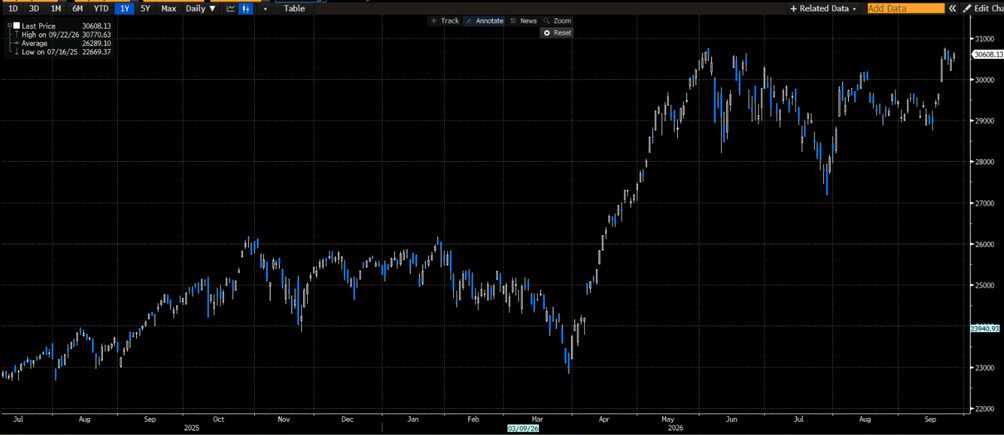
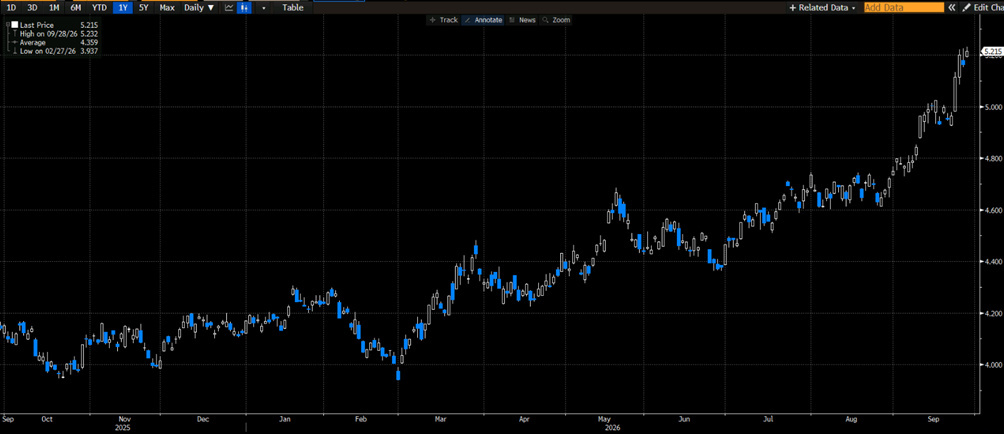
You could call it yet another confirmation of just how unreliable market forecasts can be. If anything, the rule often seems to be that exactly the opposite of the most widely shared scenario ends up happening. What is even more surprising is that equity markets resumed their climb even though one of the biggest concerns has not eased at all: after breaking above 5%, the yield on the 10-year U.S. Treasury continued to rise, coming close to 5.20% — its highest level in almost twenty years.
Oil, at least, has fallen back below 0 a barrel. But while stock prices are rising, investor sentiment remains gloomy. So today’s question is really twofold: why is the market rising when everyone is so pessimistic? And, more importantly, what is actually keeping it afloat?
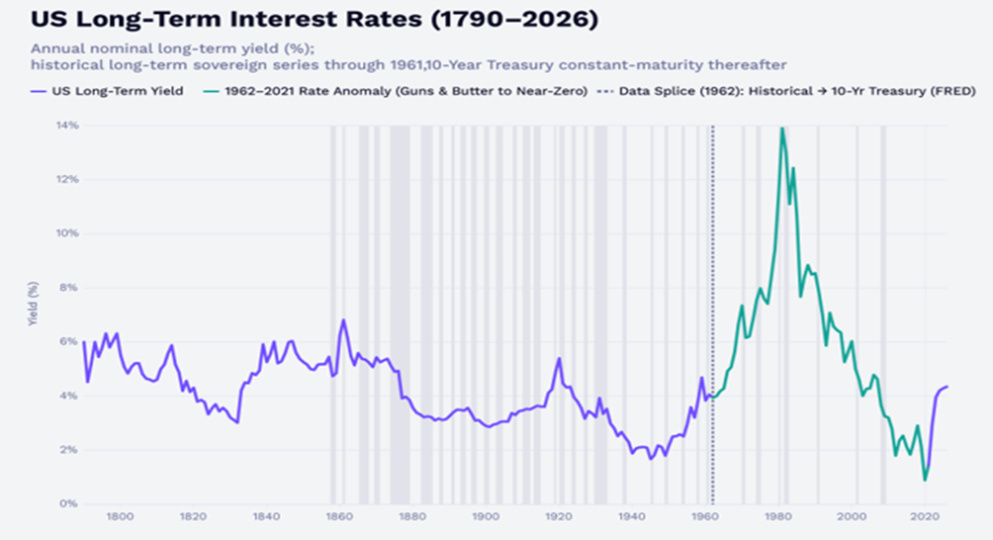
Let’s start with the number one concern: interest rates, because this deserves a direct answer. There is one idea almost everyone takes for granted: if rates keep rising, eventually they will reach a level that slows the economy down, and the stock market will suffer. That is how things have worked for the past forty years, so it almost feels like a law of nature. But Cathie Wood of ARK Invest, in her latest letter to investors, invites us to take a much longer historical view. And I think her argument is useful because it helps put today’s situation into perspective. From 1981 to 2021, interest rates fell almost continuously, from around 15–20% to nearly zero. We all grew up in that environment, and we came to think of it as normal.
But if we widen the lens to the past two centuries, that period was actually the anomaly — not what we are seeing today.
During the Industrial Revolution — which, incidentally, may be one of the closest historical parallels to the AI revolution we are living through today — interest rates remained broadly in the 3% to 6% range, while the economy expanded and stock markets continued to rise.
The key point, then, is always the same — and it is the question that really matters: why are interest rates rising?
If they were rising because inflation was spiraling out of control, that would be a serious problem. But if they are rising because the economy is genuinely growing, productivity is accelerating, and companies have an enormous need for capital to fund investment, then higher rates are a symptom of a healthy economy, not a death sentence for it. That is Wood’s bet: that artificial intelligence and other major innovations could push both growth and interest rates higher, while putting downward pressure on prices.
And there are already some signs pointing in that direction. Between 2022 and 2024, we had high interest rates and even the so-called inverted yield curve — the situation in which short-term bonds yield more than long-term bonds, something that has historically been seen as a recession warning. And yet that recession never arrived, while markets continued to rise. So yes, a 10-year Treasury yield moving toward 5.20% is striking. It makes headlines and fuels debate. But by itself, it is not a death sentence for equities. What matters is why yields are rising — and how quickly they are doing so.
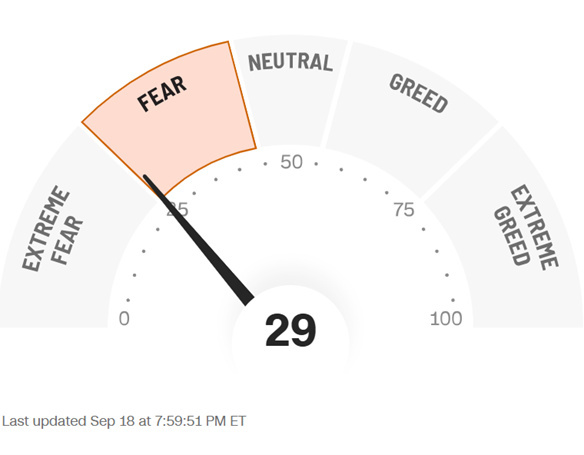
There is also a second reason not to get swept up by pessimism, and it lies in the paradox of sentiment itself. There is an old saying on Wall Street: markets “climb a wall of worry.” In other words, some of the strongest rallies often begin when skepticism is widespread, not when investors are euphoric. And right now, skepticism is running extremely high. One of the most closely watched surveys of U.S. investors shows the share of bearish investors at its highest level in more than a year, while bullish sentiment is at its lowest point of the year. CNN’s Fear & Greed Index is close to “Extreme Fear,” and even professional fund managers have reduced their equity exposure.
The two big fears are still the same: that the Fed will keep raising interest rates, and that spending on artificial intelligence will slow down. From a contrarian perspective, though, all this pessimism can actually be a positive signal. When almost everyone is already bearish and positioned for a downturn, things do not need to turn out well — they simply need to turn out less badly than feared for the market to rebound. And that is exactly what happened. As soon as oil stopped rising, equities took off again, gaining more than 3% in just three days following the Fed’s rate hike. But a rebound alone does not explain the market’s underlying resilience. To understand why the foundation is holding up, we need to look at the real pillar of the U.S. economy: the consumer.
And the numbers here are striking. Over the past three months, retail sales have grown at an annualized rate of 4%, while “core” sales — excluding gasoline and autos — have risen by more than 5%. The figure that stood out to me most, however, was restaurant spending, which jumped 10%.
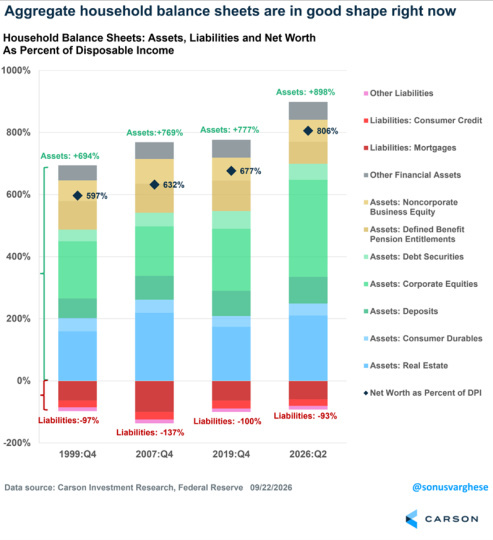
Let me explain why that matters. Eating out is usually one of the first things households cut back on when finances come under pressure. So if restaurant spending is growing at a double-digit pace — even after adjusting for inflation — it suggests that households are not simply paying higher prices: they are actually consuming more. Add to that a solid labor market — with initial jobless claims at their lowest level since 2022 — and an economy that continues to run at a strong pace. The Atlanta Fed’s estimate for growth in the current quarter stands at a robust 5%, while services activity indicators are at their highest levels in five years. Quite simply, the American consumer is not giving up, because household balance sheets remain healthy.
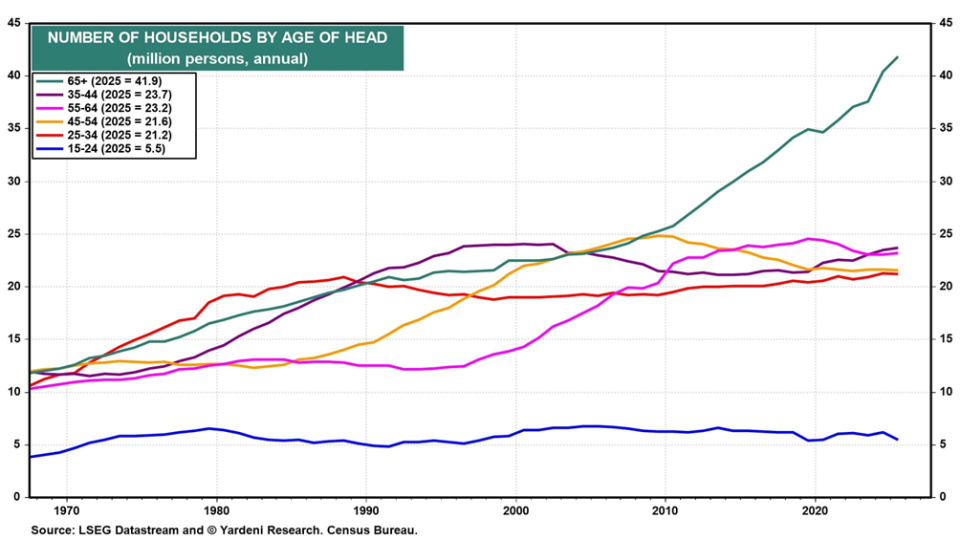
America is aging: nearly one in three households is now headed by someone over the age of 65, and this generation — the baby boomers — holds an enormous share of the country’s wealth.
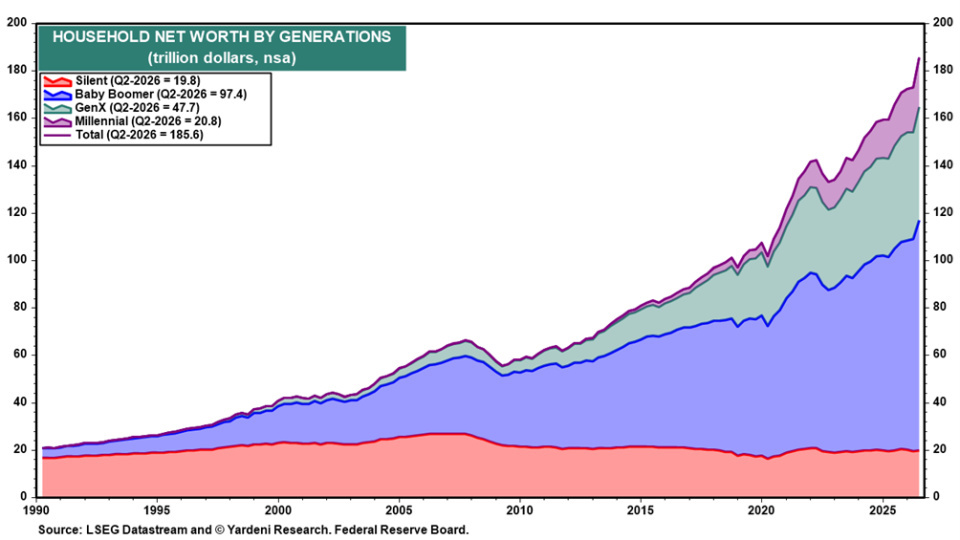
The net worth of U.S. households has reached 5 trillion, with baby boomers alone owning roughly trillion. This is an enormous stock of wealth accumulated over decades, and part of it is now being spent. That helps explain why consumption remains so resilient even as younger households struggle: spending is no longer supported only by labor income, but also by accumulated wealth. In other words, this is an economy increasingly driven by wealth, not just by paychecks.
But this is exactly where we get to the point I want to leave you with — one that turns the usual way of looking at things on its head. We normally think of the economy as the force driving the stock market: companies make more money, and share prices rise. But that chain of causality has, at least in part, started
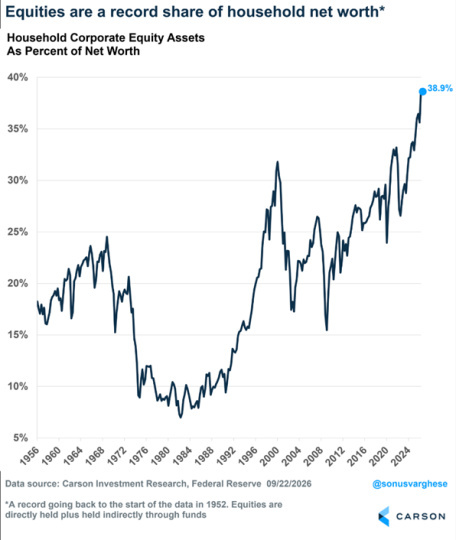
Put simply, the strength of the U.S. consumer — the engine of the economy — now depends to an unprecedented extent on the performance of the stock market. It is a self-reinforcing cycle: the market rises, households feel wealthier and spend more, companies earn more, and the market rises again.
Wonderful, as long as it lasts. The downside is that the one thing capable of breaking this mechanism would be a prolonged bear market, which could trigger the same cycle in reverse. In other words, from here on, the indicator to watch may no longer be household debt, but the S&P 500 itself. Today, the economy is more closely tied to the stock market than ever before. That said, there are still a few cracks worth monitoring.
The rebound in recent days has been driven almost entirely by technology. Tech-related sectors now account for nearly half of the entire index, while fewer than 30% of stocks are trading above their own moving averages. This is a narrow rally, carried by relatively few stocks — and narrow rallies tend to be more fragile.
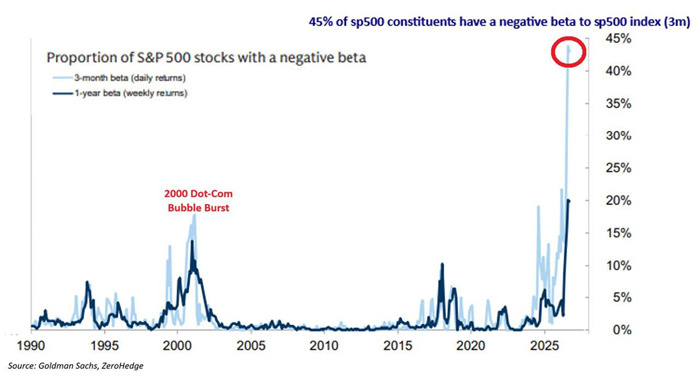
These are signals that call for selectivity, not blind enthusiasm. In a rally this heavily concentrated in technology, it makes sense to favor quality and diversification rather than chase the areas that have already run the furthest. Another important point concerns yields around 5%. They can be used to gradually build exposure to high-quality bonds, which today offer two things at once: attractive income and a valuable cushion if volatility returns or economic growth proves weaker than expected.
Finally, a note on perspective. Historically, October and November have often been among the strongest months during U.S. midterm election years. That is not a promise, of course, but it is a good reason to approach the coming weeks with clarity rather than with the fear that dominated September. Because, as this week has reminded us, markets often do exactly the opposite of what the crowd expects.
The contents of this informative message are the result of the free interpretation, evaluation and appreciation of Pharus Asset Management SA and constitute simple food for thought.
Any information and data indicated have a purely informative purpose and do not in any way represent an investment advisory service: the resulting operational decisions are to be considered taken by the user in full autonomy and at his own exclusive risk.
Pharus Asset Management SA dedicates the utmost attention and precision to the information contained in this message; nevertheless, no liability shall be accepted for errors, omissions, inaccuracies or manipulations by third parties on what is materially processed capable of affecting the correctness of the information provided and the reliability of the same, as well as for any result obtained using the said information.
It is not permitted to copy, alter, distribute, publish or use these contents on other sites for commercial use without the specific authorization of Pharus Asset Management SA.