He was right, but he lost anyway.
13 August 2026 _ News

The Aschenbrenner case: what really happened in the market? What role did financial leverage play? What can this story teach us, and why does it matter even to those who are not managing billions?*
On July 30, shortly before Wall Street opened, a single trade changed hands the entire equity portfolio of a fund, Situational Awareness, which just three weeks earlier had been one of the most celebrated in the market. Roughly billion worth of securities — long and short positions combined — were sold in a block to Citadel, Ken Griffin’s firm, at more than 10% below prevailing market prices. That same week, the fund’s founder and portfolio manager, twenty-four-year-old Leopold Aschenbrenner, was getting married: according to The Wall Street Journal, the letter informing investors of the losses was written while guests were arriving in Carmel.
In this newsletter, we examine what happened to the Situational Awareness hedge fund in order to explore the risks of extreme concentration and excessive use of financial leverage, both of which can contribute to severe liquidity crises, especially in the absence of sufficient expertise and advanced risk- and money-management procedures for investment positions.
The irony is that Aschenbrenner may be completely right about the future development of artificial intelligence, and his thesis may unfold exactly as he described it in his essay, *“Situational Awareness: The Decade Ahead.”* But that was not enough.
In a Single Month (July 2026): −67%
In July, the Situational Awareness fund lost 67% of investors’ capital, net of fees. Someone who had 100 on June 30 was left with 33 by July 31.
Before the collapse, the fund had billion in assets, meaning the gross value of its positions, most of them financed with borrowed money. By the end of the month, assets had fallen from billion to billion, although that does not mean that “ billion was wiped out.”
Assets can shrink for three distinct reasons: losses on positions, the sale of holdings — in this specific case, listed securities — and, above all, the repayment of debt. Of the three, only the first represents a loss for investors, with one important caveat: in this case, the portfolio was sold in a block at discounted prices, crystallizing the losses.
Even after the collapse, the fund remains up roughly 80% year to date.
An investor who had been in the fund since January 1 saw 100 of capital become 539 by June, then fall to 178 in July. Someone who entered on June 30, after reading about the +439% return, is now left with 33 — one-third of the capital invested.
An “Improvised” Fund Manager: Who Is Leopold Aschenbrenner?
Aschenbrenner graduated from Columbia in 2021, at the age of nineteen, at the top of his class. He worked at FTX’s philanthropic fund and later joined OpenAI’s Superalignment team, from which he was fired in the spring of 2024.
Two months later, he published a 165-page essay that became required reading across Silicon Valley. His argument was simple: if AI continues to scale, the bottleneck will not be software, but semiconductors, memory, data centers, and electricity. In the second half of 2024, he launched a hedge fund bearing the same name as the essay: roughly 5 million in initial capital, provided by Stripe founders Patrick and John Collison, Nat Friedman, and Daniel Gross; Jane Street would later invest as well. He had not spent a single day professionally managing other people’s money, and the investment team would remain tiny: four professionals, according to regulatory filings. The portfolio was essentially a literal translation of his thesis — long SK Hynix, Micron, SanDisk, CoreWeave, Nebius, Bloom Energy, and IREN, while shorting application software. The long book contained not a single share of Nvidia — although the fund did have Nvidia exposure through options — nor Microsoft, Amazon, Alphabet, or Meta. Alongside the public-markets portfolio sat a book of private investments, dominated by a stake in Anthropic.
The result: a net return of +439% in the first six months of 2026, according to the Financial Times, and more than +1,000% since launch.
The peak can be dated with precision. On July 10, SK Hynix listed on Nasdaq, raising approximately .5 billion at 9 per ADR: the largest U.S. listing ever by a foreign company, surpassing Alibaba’s 2014 record. Demand exceeded supply by more than seven times, and roughly billion of the offering went to three cornerstone investors. Alongside Baillie Gifford and Coatue was a fund that had existed for less than two years: that of the young Leopold Aschenbrenner.
«Il trend è tuo amico, tranne alla fine quando inverte» (Ed Seykota): il crollo dei chip e la ripresa dei software
Here we come to the point that most accounts tend to skip — and without it, the story does not hold together: the sell-off was not triggered by Aschenbrenner. When it began, his fund was simply one victim among many. The causes lay in the fundamentals of the memory industry and, in the background, the re-emergence of a macro risk that the market had largely stopped pricing in.
The first blow came on Monday, July 13, three days after SK Hynix’s triumphant Nasdaq listing. A note from Korea Investment & Securities estimated SK Hynix’s quarterly earnings at roughly 8% below consensus, despite year-on-year growth of more than 500%. The reason was technical — and unwelcome: SK Hynix sells HBM memory under multi-year fixed-price contracts, which means it does not fully capture increases in spot market prices.
The shares fell 15.4% in Seoul, the worst session in the company’s history, wiping out roughly 0 billion in market capitalization. That same day, markets were also hit by tensions between the United States and Iran around the Strait of Hormuz and a sharp rise in oil prices. The Kospi closed down 8.95%, its worst session since the pandemic, triggering the seventh circuit breaker of 2026. It would not be an isolated episode: during July, SK Hynix would post three separate sessions with declines of roughly 15% each.
The second blow — much larger — came on July 27 and 28, when three separate developments converged within the same forty-eight-hour window.
Chinese memory producer CXMT made its debut on Shanghai’s STAR Market, closing more than 400% higher and raising approximately .6 billion to expand DRAM production capacity. At the same time, reports emerged that China had begun domestic production of immersion DUV lithography equipment — precisely the kind of capability Western export controls were intended to prevent. And doubts resurfaced over the cross-financing relationship between Nvidia and OpenAI. Reports referred to as much as 0 billion in Nvidia guarantees linked to an Ohio data-center project and up to 0 billion in OpenAI chip purchases — raising fresh concerns about the circularity of AI demand. On July 28, Samsung closed down 13.4%, SK Hynix fell 14.7%, and the Kospi dropped 10.84%. A circuit breaker was triggered, halting trading for twenty minutes — the eighth such event of 2026.
The following day, SK Hynix reported the most profitable quarter in its history and still fell, because expectations had been even higher. The circuit breaker was triggered for a second consecutive session, the first time this had ever happened in the history of the Korean stock market. In just two days, the index lost more than 18%, taking its decline since the beginning of the month to 28.9% — a pace that, by then, was worse than during either 1997 or 2008. The ADRs that had listed in New York only eighteen days earlier were already trading below their offering price. Across the sector, the Philadelphia Semiconductor Index fell 21% during the month — its worst monthly performance since October 2008 — wiping out roughly .2 trillion in market capitalization and leaving the index 28.6% below its June 22 peak. Globally, the losses had risen to more than trillion since the beginning of June.
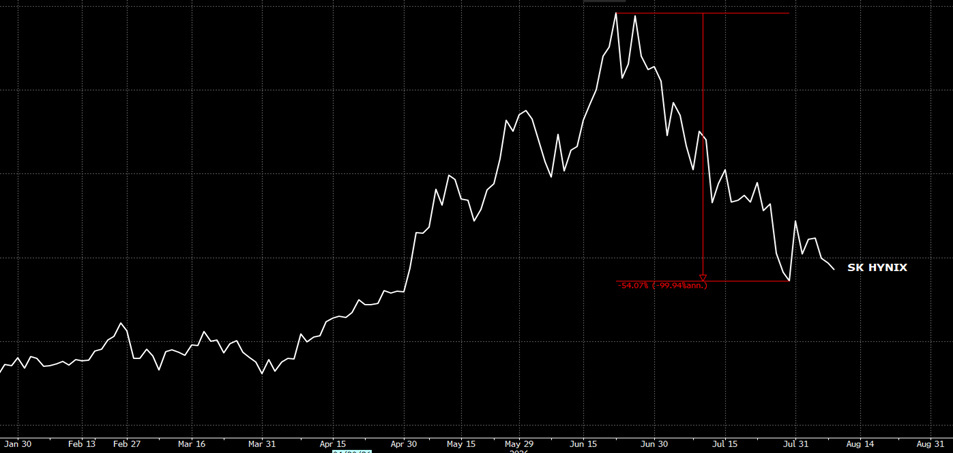
SK Hynix, Seoul-listed shares in 2026: −54.1% over the highlighted period (from the peak to the recent low), followed by the July 31 rebound after the liquidation was completed. Over the full month, the stock lost 35%. Source: Bloomberg.
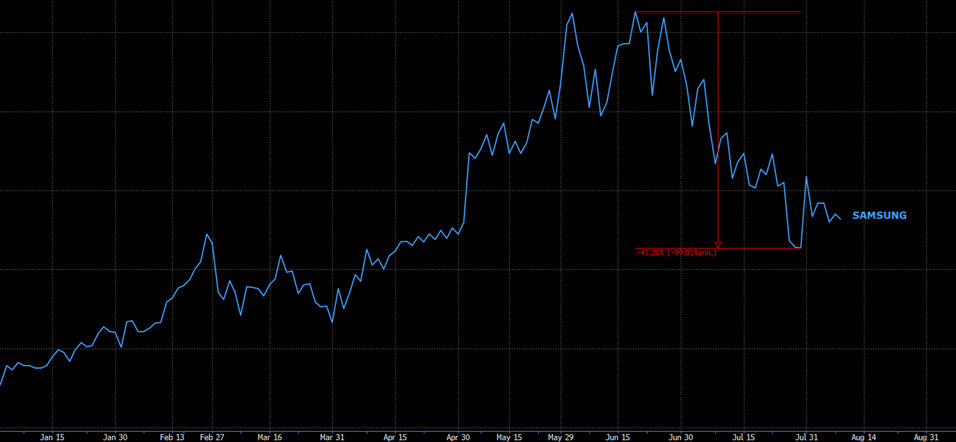
Samsung Electronics, Seoul-listed shares in 2026: −41.2% over the highlighted period (from the peak to the recent low). Over the full month, the stock lost 21%. Source: Bloomberg.
And Then Came the Leverage
Up to this point, this was a violent but explainable valuation correction. It is here that Aschenbrenner’s position stops being merely an effect and becomes a cause of the amplification.
According to The Wall Street Journal, the fund borrowed three to four dollars for every dollar of capital, “and sometimes more,” with options layered on top; reconstructions broadly converge on gross exposure of around four times capital. In the fund’s contractual documentation, as reported by the U.S. press, it was explicitly stated that there would be no limits on the type of investments, portfolio concentration, or leverage. No one was misled: it was all there in writing.
From that point on, the mechanism is the same as in every forced liquidation. Prices fall and the value of collateral declines. Prime brokers — Goldman Sachs, JPMorgan, and Bank of America, with Citigroup among the banks that later helped facilitate the transaction with Citadel — demand additional margin, with deadlines measured in hours, not quarters.
To raise cash, the fund has to sell precisely the securities that are already falling, and those sales push prices even lower. There was an additional complication: the long book was public through quarterly filings — unlike the short book, which 13F filings do not require managers to disclose — and Aschenbrenner had developed an almost cult-like following on social media, with thousands of retail investors replicating his portfolio.
During the crisis, moreover, the prime brokers themselves were sounding out the market on both sides of the book. Once the market understood what was about to be sold, it positioned itself ahead of the liquidation — and his “copycats” sold alongside him.
That this was above all a positioning crisis, rather than a crisis of fundamentals, is not just our interpretation. Goldman Sachs argued that the sell-off reflected positioning at least as much as deteriorating fundamentals, while the head of research at KB Securities described the move as more a short-term distortion in trading dynamics than a sign of worsening fundamentals. There are also several clues that are hard to ignore.
— The broader market barely moved. While AI-related stocks were collapsing, the S&P 500 — and especially its equal-weighted version — held up, while the Russell 2000 had finished the first half up 22.6%. That is not how a recession behaves.
— As soon as the forced selling ended, the market rebounded. On July 31, with the liquidation completed, the Kospi gained 18% in a single session, the largest one-day increase in its history, led by Samsung and SK Hynix. July therefore ended down 22%, making it the worst month since October 2008 rather than the worst ever, while 30-day volatility rose to its highest level since 1990.
To be fair, the rebound was also helped by better-than-expected earnings from Microsoft, Amazon, and Meta, released the previous night. Jim Cramer, speaking on CNBC, called it a “clearing event”: once it was over, there were no more forced sellers left.
The most telling case was ServiceNow — not a short position held by the fund, but a symbol of the “short software” trade. It reported a solid quarter at the end of July and, for the first time that year, the stock rose rather than fell. Situational Awareness’s documented software short, by contrast, was Adobe.
In short: the news determined the direction; leverage determined the violence.
The Arithmetic: The Boring Part, and the Only Part That Matters
One final line of defense remained: the fund’s software shorts, which in theory should have made money when the long positions were losing. They did not. “Long AI infrastructure, short software” looked like two separate bets. In reality, it was the same bet written twice: a bet on the momentum factor. Once the factor reversed, both sides of the portfolio lost at the same time.The number that makes this clear is straightforward: over the same period in which the semiconductor index fell 28.6% from its peak, the Morgan Stanley Momentum TMT Index lost 53.5%.
The rest is arithmetic. With 100 of capital supporting roughly 400 of gross exposure — four times leverage, the figure on which the various reconstructions broadly converge — a 10% decline in the underlying assets wipes out 40, or 40% of the fund’s capital. A complete example: 250 in long positions falling 25% produces a loss of 62.5; 150 in short positions rising 5% produces another loss of 7.5; total loss: 70 on 100 of capital. Moves that, without debt, would have amounted to an unpleasant month can wipe out two-thirds of the fund’s equity. And losses are not symmetric with recoveries:

Risk management is not a boring add-on to a good idea: it is the necessary condition for giving that idea enough time to work.
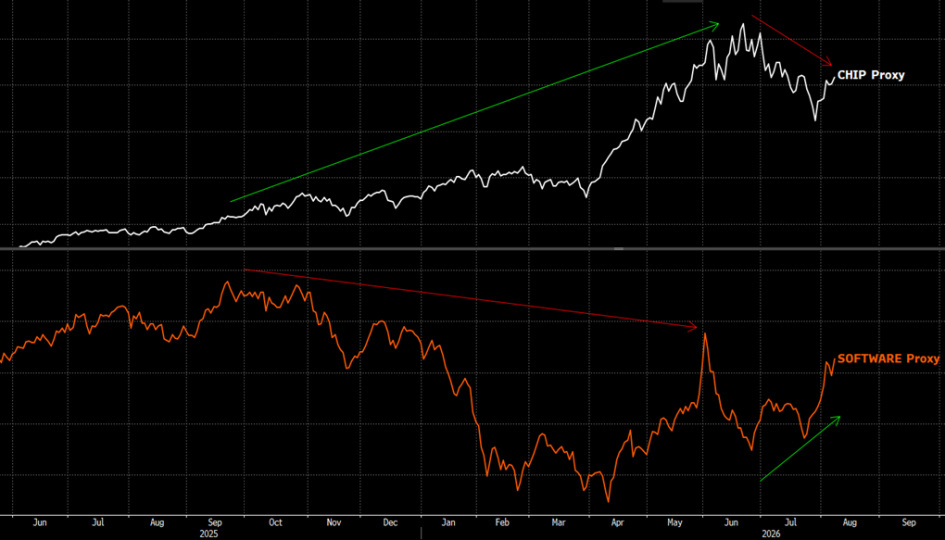
The two legs of the same bet: semiconductor proxy (top) and software proxy (bottom), June 2025–August 2026. Source: Bloomberg.
What Was Left?
After the sale to Citadel, the private book remained — the unlisted holdings: the stake in Anthropic, valued at around billion, along with Fluidstack, MatX, and Physical Intelligence.
And here lies the irony. The position that survived was not the most conservative one at all — it was the purest and most concentrated expression of the exact same thesis. And it did not survive by choice: during the crisis, Aschenbrenner tried to place a .5 billion slice of the Anthropic stake with Sequoia and Greenoaks, but the deal fell through.
It survived because it was private. No one was marking it to market every second, no bank was holding it as collateral, and no margin call could be made against it. Liquidity — usually considered a virtue — was the very channel through which the fund was dismantled. It remains unclear, agencies have cautioned, whether the fund formally received margin calls before closing the deal with Citadel. What is certain is that it repaid its lenders and did not default. In the letter sent after the liquidation, Aschenbrenner wrote that he took full responsibility, compared what had happened to a bank run — vulnerability creating further vulnerability — and announced that, from now on, the public-markets book would be run without leverage, funded entirely with equity capital.
He also added a sentence worth more than the 165 pages of his essay: the fund must always be structured so that it can take a loss and live to fight another day.
One note of caution, however, before turning all of this into an invitation to buy the dip. After Archegos collapsed in 2021, the market told itself the same story: “everything will recover once the forced selling is over.” More than five years later, most of those stocks are still trading below their liquidation prices.
What Can We Take Away From This?
—Survival comes before being right. The thesis may prove correct three years from now; that is irrelevant if the portfolio no longer exists three weeks from now. The investment idea and the way it is financed are two separate decisions, and the second determines whether the first will ever get the chance to be tested.
— Leverage does not increase expected return: it compresses the time horizon. The moment you borrow, your time horizon becomes your creditor’s time horizon. That is why a ten-year thesis should not be financed on margin.
— A hedge is only a hedge if the underlying risk factor is different. If both legs depend on the same force — momentum, risk appetite, real rates — the portfolio is not balanced. It is simply the same bet doubled.
— If everyone is copying the trade, the exit is no longer yours alone. Well-known, crowded positions mean that your forced seller is also everyone else’s forced seller. That is why the same piece of news can produce a 5% decline in a lightly owned stock and a 50% decline in a heavily crowded one.
—Less than two years of track record is not proof of skill. It is a sample collected under a single market regime. Someone who has never been through an adverse cycle has not yet demonstrated an ability to manage risk; they have demonstrated that they chose a good time to start.
None of us has a prime broker, but the same dynamics exist on a smaller scale in products that can be bought from home in three clicks: 2x and 3x leveraged ETFs, margin accounts, perpetual crypto derivatives, and thematic ETFs so concentrated that they amount to ten versions of the same bet.
And this is not merely an analogy. In this very episode, single-stock leveraged ETFs listed in Asia on names such as SK Hynix had grown enormously and, when the underlying shares fell, they had to sell in order to maintain 2x exposure, feeding the downward spiral. Some of the largest leveraged ETFs on SK Hynix lost nearly 50% from the time of the company’s Seoul listing in late May, and Korea intervened by halting new issuance and imposing cash-deposit requirements from July 31.
One number captures the scale of what happened: since 2000, the Korean stock market has triggered thirteen circuit breakers on the Kospi, seven of them in 2026 alone.
There is only one rule: before asking how much you can make, you need to know under what circumstances you can be forced to sell. If the answer includes the words “when someone else tells me to,” the position is too large. This is not a moralistic reading of the story. On August 5, the CEO of Bank of America — one of the banks involved — described the episode as a warning shot for markets fueled by high valuations and borrowed money. And Aschenbrenner was certainly not the only one who paid the price.
On the market, there is no prize for having been right. There is only a prize for having been right and still being there.
The contents of this informative message are the result of the free interpretation, evaluation and appreciation of Pharus Asset Management SA and constitute simple food for thought.
Any information and data indicated have a purely informative purpose and do not in any way represent an investment advisory service: the resulting operational decisions are to be considered taken by the user in full autonomy and at his own exclusive risk.
Pharus Asset Management SA dedicates the utmost attention and precision to the information contained in this message; nevertheless, no liability shall be accepted for errors, omissions, inaccuracies or manipulations by third parties on what is materially processed capable of affecting the correctness of the information provided and the reliability of the same, as well as for any result obtained using the said information.
It is not permitted to copy, alter, distribute, publish or use these contents on other sites for commercial use without the specific authorization of Pharus Asset Management SA.