July 2026 Fed Meeting: Warsh Sounds Hawkish, but the Market Wanted Action
06 August 2026 _ News

This week brought an event that marks a turning point in how the world’s most important central bank operates. On Wednesday, the Federal Reserve left interest rates unchanged at between 3.50% and 3.75%. No surprise there. The surprise came from the way Kevin Warsh handled the Fed’s communication—and from the bond market’s extremely harsh reaction. Because the real message of the week is not what the Fed decided, but the fact that it chose to say much, much less. And the markets did not respond well to that silence.
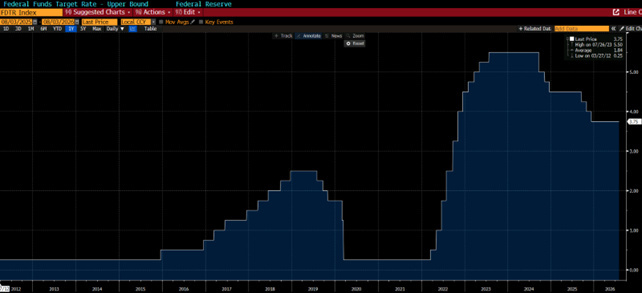
Let’s start with the facts. The official statement was just 166 words long, roughly one-third the length of those issued during the Powell era. No dot plot—the chart showing policymakers’ projections for future interest rates—was published. And during the press conference, Warsh provided very little forward guidance.
His stated philosophy is that the Fed should no longer guide markets step by step. He wants investors, in his own words, to “learn to play the ball, not referee the game,” focusing on real economic data rather than on the central bank’s language.This marks a major shift from the past twenty years, when markets were effectively led by the hand. In fact, more often than not, the central bank delivered exactly what investors expected.
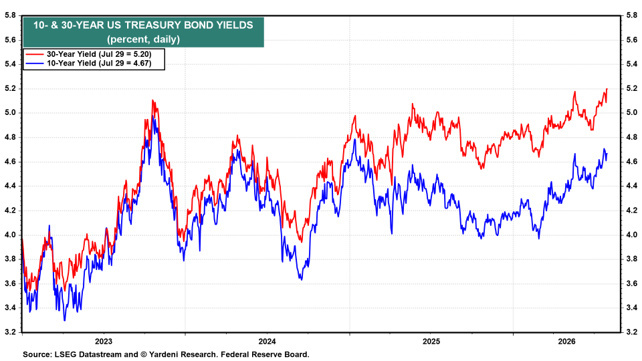
The problem is that this shift came at a moment of intense tension. The internal vote was more hawkish than expected: three members dissented, calling for an immediate rate hike. The two-year Treasury yield fell to 4.23%, as some investors had already positioned for a hike at this meeting. But the thirty-year yield moved in the opposite direction, rising above 5.20%, its highest level in almost nineteen years.
This move is known as a bear steepening: long-term yields rise more than short-term yields. The message is concerning. The market fears that inflation, oil prices and fiscal deficits will remain elevated for a long time, and is therefore demanding a higher return to lend money to the United States for thirty years.
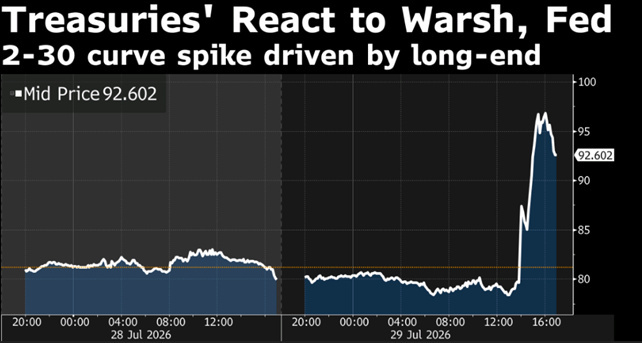
On Wall Street, there is a name for the investors driving this phenomenon: the “bond vigilantes.”These are investors who, when they believe a central bank is not doing enough to fight inflation, sell long-term bonds and push yields higher, effectively forcing the Fed’s hand.
This week, they made their presence felt. Warsh sounded hawkish. He reiterated that the inflation target is 2%, with no room for compromise, and that “there is no such thing as a soft inflation target.”But his words were not followed by action—namely, a rate hike. And the market’s response was clear: strong words are not enough. Investors want to see action.
I would be cautious about saying that Warsh has already failed. It is normal for markets to test every new Fed chair, and historically equities have experienced meaningful corrections in the three to six months following a new appointment. But the signal should not be ignored: with less guidance from the Fed, volatility is likely to increase, particularly at the long end of the yield curve.
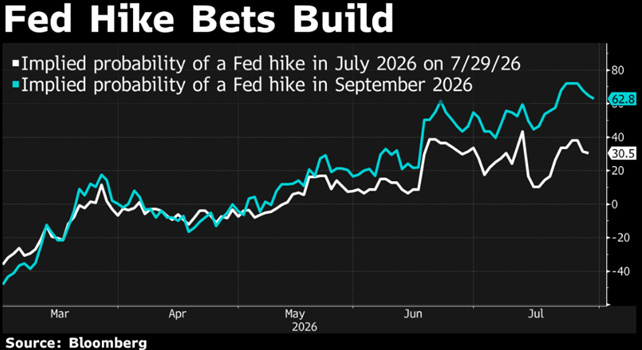
Markets are now pricing in roughly a 60% probability of a rate hike in September, with one full increase fully priced in by December. To avoid that outcome, inflation and the labour market will need to cool clearly and convincingly.
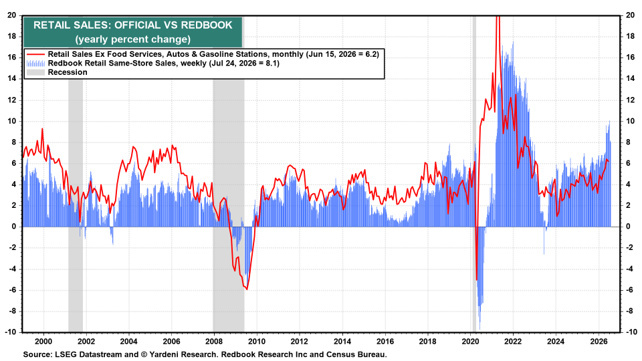
And this is the key point: this week’s data tell the opposite story. The US economy is still running at full speed. Second-quarter GDP grew by just 1.5%, but that figure is misleading. Growth was dragged down by an 11.5% surge in imports—mainly technology linked to artificial intelligence—which are subtracted in the GDP calculation. Under the surface, real domestic demand grew by 3.9%, the strongest pace since early 2023. Consumer spending increased by 3.2%, while business investment rose by 8.4%. This is not an economy that is slowing down. It is an economy that is still expanding strongly—and one that risks transmitting the inflationary shocks ahead across the entire system: tariffs, the boom in AI-related spending and persistently high oil prices.
Because inflation is far from under control.
The June PCE reading offered a small degree of relief, with the monthly figure falling by 0.1% thanks to lower gasoline prices. But on a year-over-year basis, inflation is still running at 3.7%, while core PCE stands at 3.3%—well above the Fed’s 2% target. And that decline in gasoline prices reflects a month in which oil had fallen. With the war escalating again and crude prices rising, June’s benign reading is more likely to prove an exception than the beginning of a trend. The second major theme is the semiconductor paradox, a perfect illustration of just how nervous this market has become.
Three examples. Corning beat expectations on both earnings and revenue, yet its shares fell 12%. NXP reported 19% revenue growth and issued guidance above consensus, but the stock opened 4.5% lower the following day. Vertiv raised its forecasts, and its shares plunged by almost 14%.
None of these companies disappointed. Two out of three raised their guidance, yet all three were punished. What does this tell us? The message is clear: the market has stopped rewarding good results.
When a stock is priced for perfection, even a minor revenue miss or rounding difference can trigger a double-digit collapse. Importantly, this is not a problem with fundamentals. Semiconductor earnings are growing by more than 130% this quarter and, on their own, account for roughly 44% of the index’s total earnings growth.
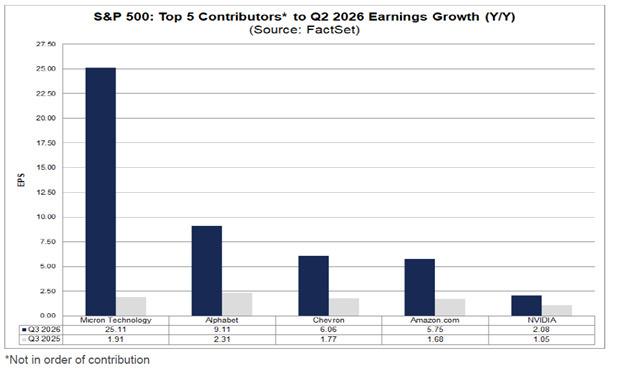
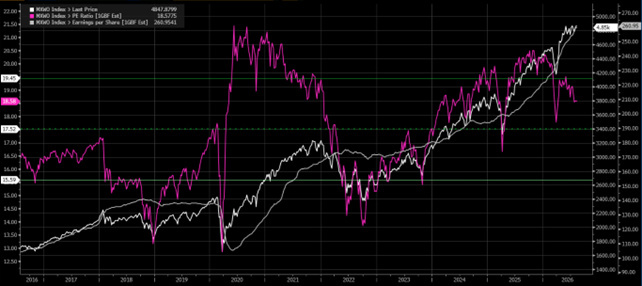
This is a problem of sentiment and valuations. It is a case of multiple compression: the market is willing to pay less for the same level of earnings. The semiconductor index has fallen by more than 25% from its June highs, a correction that is more than understandable after the extraordinary gains of recent months. Supporting a more constructive interpretation is the ongoing market rotation. While capital has been moving out of chip stocks, it has not left the equity market altogether. The Equal Weight Index reached a new record precisely during the semiconductor sell-off, while industrials, healthcare and financials continued to attract inflows.
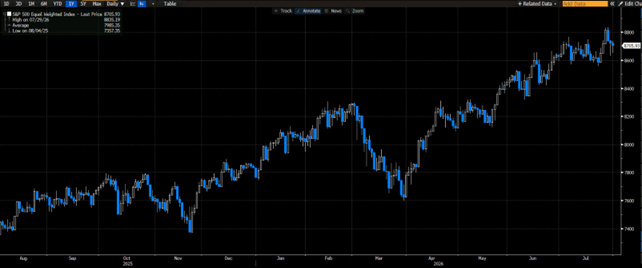
Industrials are the second-best-performing sector of the year, supported by AI-related spending. The billions invested in data centres are turning into real orders for companies that manufacture machinery and equipment. The market is not running away: it is reorganising.
What are the main takeaways?
First, we should prepare for greater volatility in long-term interest rates. Long-dated bonds are highly attractive at current levels, but investors who hold them in their portfolios should remain aware of the risks.
Second, when it comes to semiconductors, buying strong companies during periods of panic has often proved rewarding—but never all at once, and never by chasing the first rebound.
Third, investors should pay attention to the rotation towards industrials, healthcare and financials, which reflects where earnings and cash flows are moving.
Finally, with yields at these levels, holding cash and short-term government bonds is no longer a zero-return parking place. It now offers a real yield and provides dry powder for when volatility creates new opportunities.
To sum up, this week the Fed changed the rules of the game. It chose to communicate less and left markets to interpret the economy for themselves. Warsh sounded hawkish, but he did not act hawkishly. The bond market presented him with the bill, pushing long-term yields to their highest levels in almost twenty years. Beneath the surface, the economy continues to run at full speed, while inflation remains stubbornly high.
This is not a crisis scenario. But it requires clarity, discipline and an awareness that, from now on, we will all have to follow Warsh’s advice: learn to play the ball, while applying the right interpretation to each phase of the market.
The contents of this informative message are the result of the free interpretation, evaluation and appreciation of Pharus Asset Management SA and constitute simple food for thought.
Any information and data indicated have a purely informative purpose and do not in any way represent an investment advisory service: the resulting operational decisions are to be considered taken by the user in full autonomy and at his own exclusive risk.
Pharus Asset Management SA dedicates the utmost attention and precision to the information contained in this message; nevertheless, no liability shall be accepted for errors, omissions, inaccuracies or manipulations by third parties on what is materially processed capable of affecting the correctness of the information provided and the reliability of the same, as well as for any result obtained using the said information.
It is not permitted to copy, alter, distribute, publish or use these contents on other sites for commercial use without the specific authorization of Pharus Asset Management SA.