Market Volatility and Investing: How to Manage Downturns and Rebounds
19 November 2026 _ News

Over the past two weeks, the markets have shown us just about everything they’ve got. The S&P 500 had its worst day since April 2025, with semiconductors down 12%—their second-worst session ever after March 2020. Then, the following Monday, a 2.4% rebound. In between, we saw hotter-than-expected inflation data, the U.S. 10-year Treasury yield climbing back above 5%, and even the surprise resignation of Nvidia’s founder, the face of artificial intelligence. Weeks like these test our nerves more than they do our analysis. So today, I want to start with a simple question: How much volatility is normal, and how do we cope with it without making decisions we’ll regret?
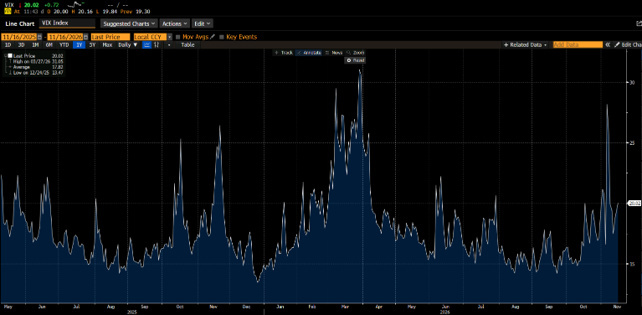
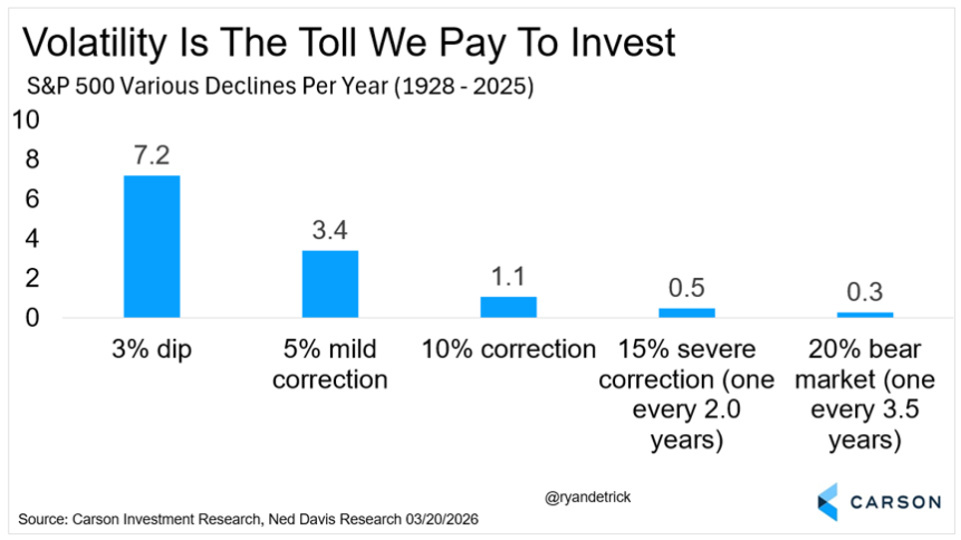
Whether we like it or not, volatility is the price we pay for investing. This isn’t just a consoling remark—it’s the numbers. On average, each year, the S&P 500 experiences more than three 5% declines and one 10% correction, and a bear market (with declines of more than 20%) occurs about every three and a half years.
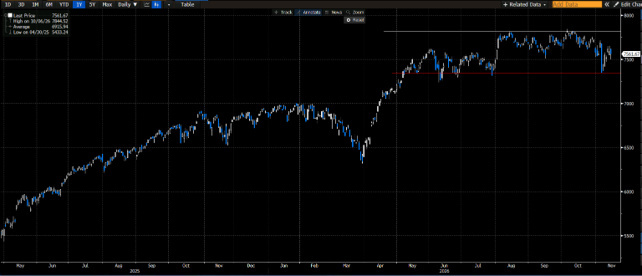
To put it in perspective, this year’s drop in early November is only the second 5% decline, following the correction in February and March linked to the start of the war with Iran. And it came after months of unusual calm: from late May to late October, the index had remained virtually unchanged, within one of the narrowest ranges in its history.
We were simply unaccustomed to volatility. But there’s more to it: volatility isn’t a flaw in stocks—it’s precisely the reason they generate returns. If the stock markets were as stable as a savings account, they would yield returns like a savings account. It’s because prices fluctuate—and sometimes drop significantly—that investors demand a higher return to hold stocks in their portfolios. This is the so-called risk premium: compensation for bearing uncertainty. In other words, days like the one in early November are the price of admission, and the long-term return is what that admission ticket buys us. There’s an old Wall Street saying that aptly describes what we’ve experienced: the market goes up on the escalator and down in the elevator.
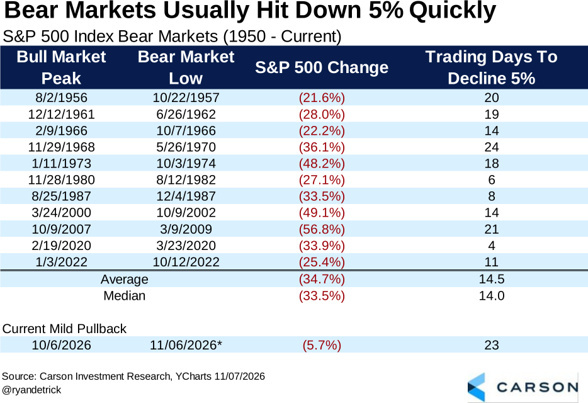
There’s also one indicator I find particularly useful: From its early-October high, it took 23 trading days for the S&P 500 to lose 5%. In past bear markets, however, the first 5% was lost on average in about 14 days, and only once did it take longer than it did this time. In other words, true bear markets tend to get off to a fast start. A slow and gradual decline, like this one, is historically more typical of a normal correction than of the beginning of something more serious. It’s no guarantee, but it’s a good antidote to the temptation to see every downturn as the beginning of the end.
And then there is perhaps the most valuable lesson of all: the best days almost always come right after the worst ones. After a 4.4% drop on Thursday, November 5, the S&P 500 rose 2.4% the following Monday; the Nasdaq posted its best day of the year; and more than 420 stocks in the index closed higher—the best performance in nearly a year. Those who sold in a panic on Thursday missed out on Monday’s rebound. Today, the S&P 500 is less than 3% below its highs, and its equally-weighted version has already returned to its record high. Meanwhile, market sentiment has plummeted: the ratio of optimistic to pessimistic investors dropped sharply after the panic, and historically, such widespread pessimism has more often been a constructive signal than a cause for concern.
Even the most sensational news stories of the past two weeks should be viewed through this lens. The first is Jensen Huang’s departure from the helm of Nvidia after 33 years—a development that, until just a few days ago, would have seemed almost impossible—following two personal incidents, one of which involved a company suspected of reselling chips in China in circumvention of U.S. bans.
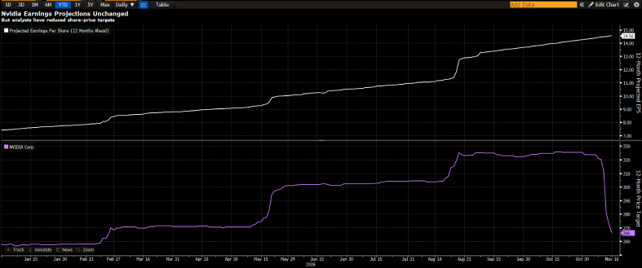
The second is the upcoming IPO of Anthropic, the company behind Claude, which is set to become one of the key litmus tests for the valuations assigned to artificial intelligence companies. What really matters, however, are the implications for the entire ecosystem, because Nvidia isn’t just the leading chip supplier—it’s also one of the major financiers of this extraordinary investment cycle. And there are some real risks, ranging from potentially stricter export controls to competition that was already eroding market share. It’s no surprise, then, that the market is reacting nervously, pricing in uncertainty that could weigh on the sector for days, if not weeks. It must be said, however, that—for now—money isn’t fleeing the AI sector: on the day of the resignation, competitors AMD and Broadcom rose by more than 5%, and demand remains extremely strong, with revenues at CoreWeave—one of the major providers of computing power—up 168%. With Nvidia’s earnings report coming up and another major capital markets transaction this week, the coming trading sessions could be decisive in determining whether the rally will regain momentum or whether a further sell-off is in store.
Instead, the focus over the next few weeks will be on the Fed. October’s inflation figures came in higher than expected, with the core index rising 0.3% for the third consecutive month, and the number of small business owners planning to raise prices is at its highest level since 2022.
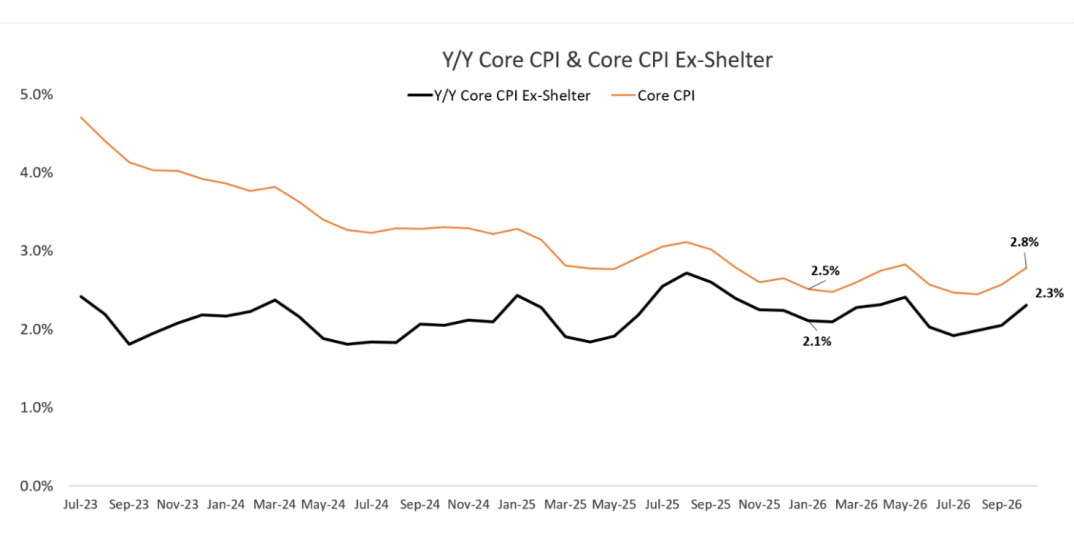
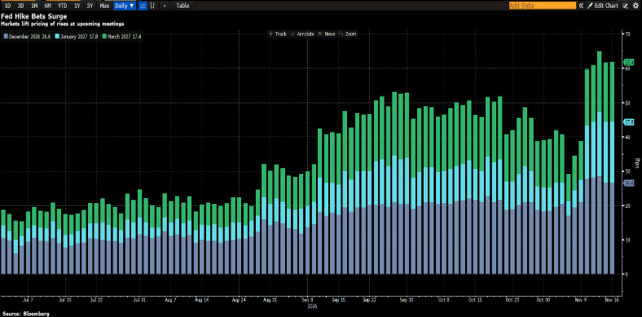
With the economy continuing to grow strongly, Governor Waller has signaled a half-point rate hike in December, and the market now considers a rate hike on December 9 a certainty, with more than three rate hikes priced in over the next twelve months.
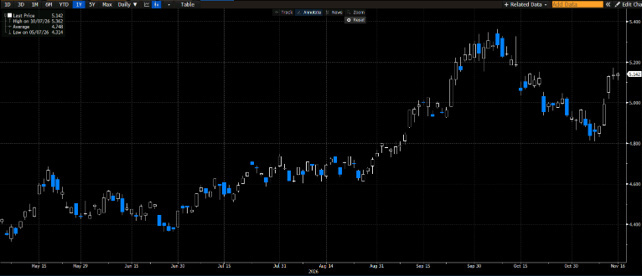
The 10-year yield has risen back above 5%. Here's the point: more than individual companies, it is the cost of capital that determines how much the market is willing to pay for earnings.
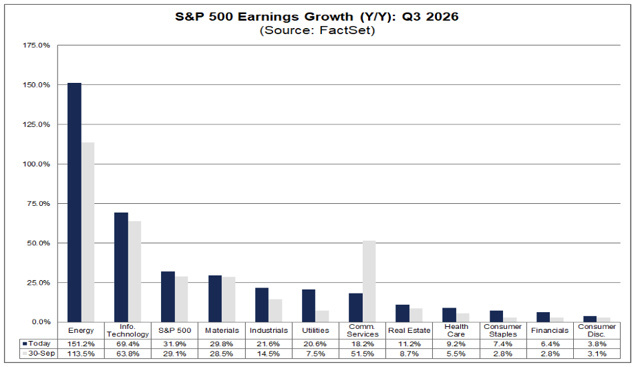
What can we take away from this? First: volatility isn’t an accident—it’s the price we pay for long-term returns. 5% drops happen several times a year, and how they unfold matters: slow declines, like this one, rarely mark the start of a bear market. Second: don’t sell after the worst days, because the best days often come right after, and those who exit on the wave of emotion usually re-enter at higher prices. Third: When faced with shocking news, distinguish between its impact on an individual stock and its impact on the broader market cycle. And keep your eyes on what really matters over the coming weeks—namely, inflation and the Fed—as well as, of course, earnings and thus earnings season, the true driver of long-term stock returns.
The contents of this informative message are the result of the free interpretation, evaluation and appreciation of Pharus Asset Management SA and constitute simple food for thought.
Any information and data indicated have a purely informative purpose and do not in any way represent an investment advisory service: the resulting operational decisions are to be considered taken by the user in full autonomy and at his own exclusive risk.
Pharus Asset Management SA dedicates the utmost attention and precision to the information contained in this message; nevertheless, no liability shall be accepted for errors, omissions, inaccuracies or manipulations by third parties on what is materially processed capable of affecting the correctness of the information provided and the reliability of the same, as well as for any result obtained using the said information.
It is not permitted to copy, alter, distribute, publish or use these contents on other sites for commercial use without the specific authorization of Pharus Asset Management SA.