The Fed hikes, earnings soar: but how long can this strength last?
24 September 2026 _ News

This week, we’re looking at two stories that may seem unrelated, but actually raise the very same question.
The first is about the Federal Reserve, which raised interest rates for the first time in three years. The second is about the earnings cycle of U.S. companies, with profits growing at a pace we haven’t seen in quite some time. On one side, we have a central bank hitting the brakes. On the other, corporate profits are accelerating. And the common thread is this: how solid is the strength we’re seeing — and, more importantly, how long can it last?
Because in the end, both interest rates and earnings depend on the answer to that question.
Let’s take them one at a time. Let’s start with the Fed, because it was the key event of the week. The Federal Reserve raised interest rates by a quarter of a percentage point, bringing the target range to 3.75%–4%. It was the first rate hike since January 2023. The decision was unanimous, with all twelve members voting in favor, and Fed Chair Kevin Warsh reiterated that “inflation is too high and has been too high for too long.”
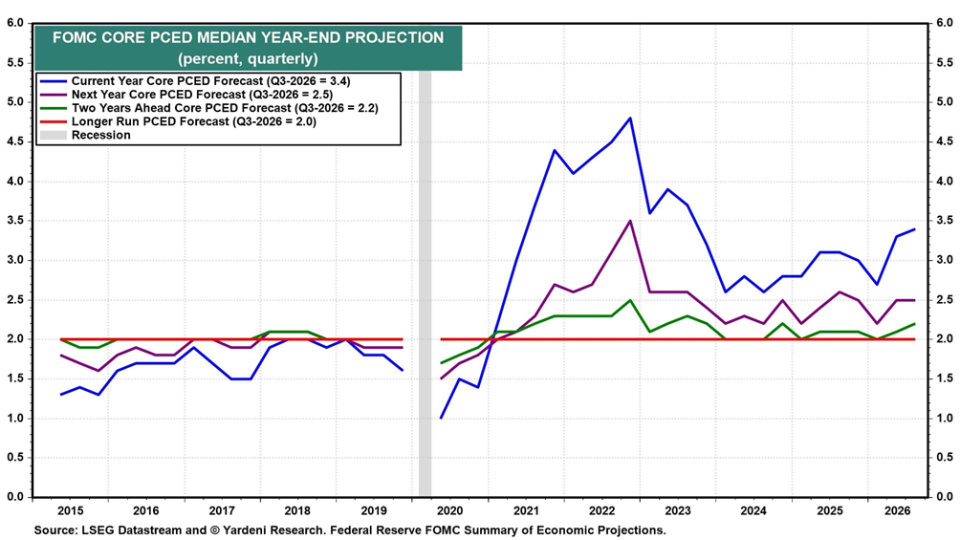
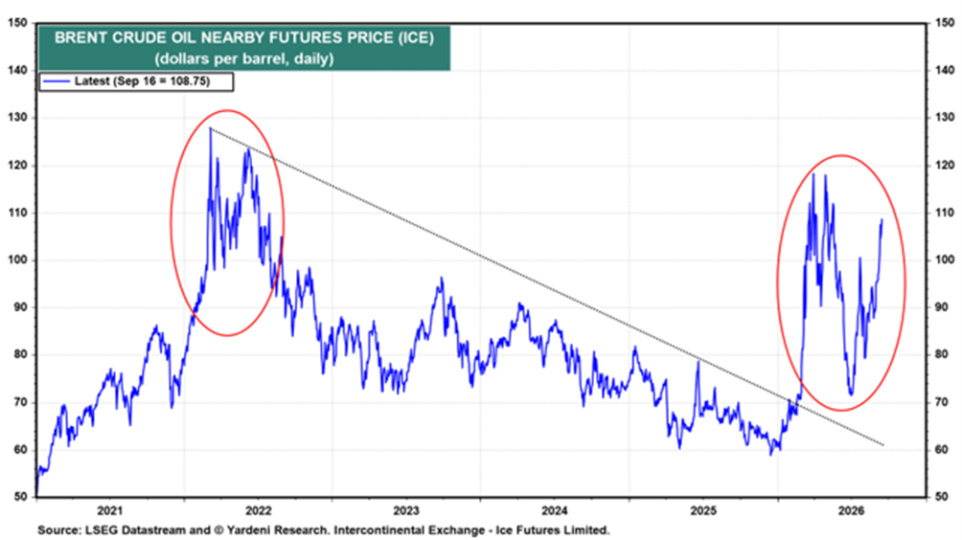
Many interpreted all of this as a hawkish signal — the beginning of a prolonged tightening cycle. And in fact, the U.S. 10-year Treasury yield climbed close to 5%, its highest level in nearly twenty years, driven by oil prices moving back above 0, inflation remaining sticky, and, to some extent, technical factors coming from abroad, particularly from Japan.
But here I want to offer two ways of looking at this that go beyond the headlines.
The first is that this rate hike is less hawkish than it may seem. Fed officials’ projections point to, at most, one more move this year and essentially nothing next year. In other words, this is not the start of a rapid series of rate increases.
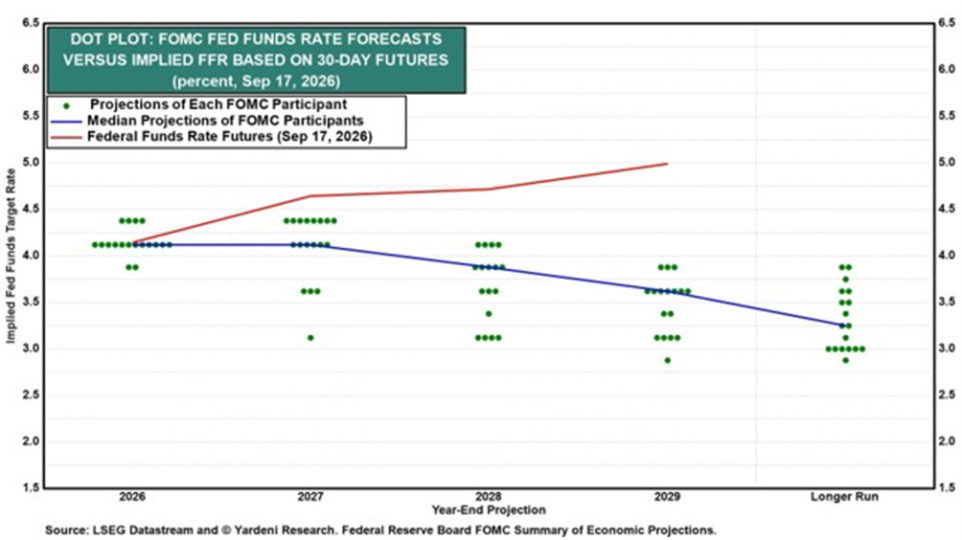
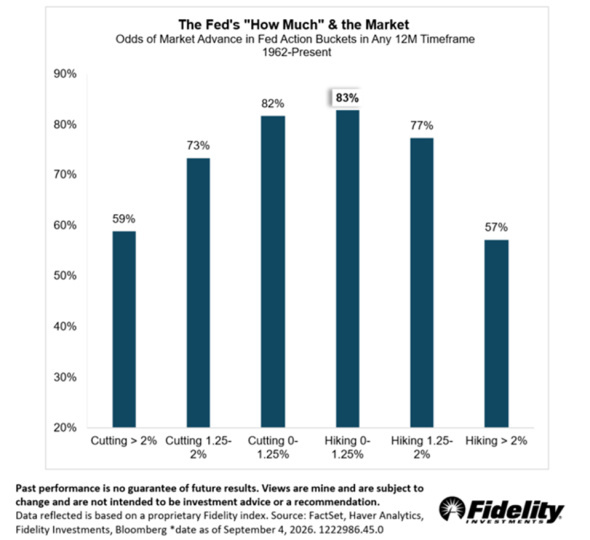
In fact, several observers have described it as almost a dovish move disguised as a hawkish one — a way to preserve the central bank’s credibility in the eyes of the market. The second perspective, and the one I find most valuable, comes from a Fidelity study. According to the analysis, the right question is not whether the Fed will raise rates again, but how far behind the economy it may be. History shows that a first rate hike, or a modest tightening cycle, is usually manageable for equity markets. The real problem begins when the central bank realizes it has fallen too far behind and is forced to chase inflation with rapid, aggressive rate increases, as happened in 2022. That is not the situation today. The Fed is simply removing some of the policy accommodation. Put simply: it is not the first rate hikes that kill bull markets. Recessions do. And for now, there are no clear signs of one.
But precisely because everything ultimately depends on the health of the economy, we now need to turn to the other key pillar of the week — and the real engine of this market: earnings. According to data compiled by FactSet, S&P 500 earnings grew by 51% in the second quarter and by 26% over the past year, compared with a historical average of around 7%.
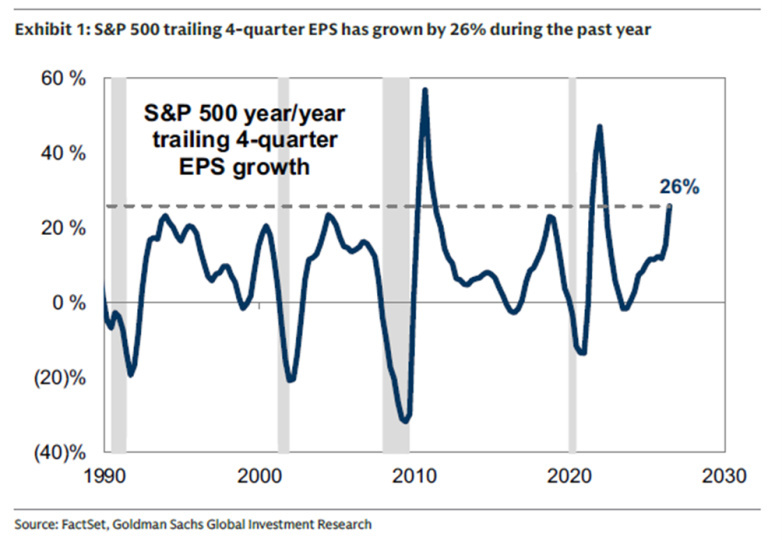
Growth this strong has only been seen a few times in recent decades, usually during rebounds following a recession. But this time, there was no recession.
So it is fair to ask: could this be an “earnings bubble”, with inflated profits that are eventually bound to come back down?
Looking more closely at the numbers, the answer is no — and for one specific reason: valuations remain reasonable. The forward price-to-earnings ratio stands at around 19 times earnings, broadly in line with its ten-year average and actually lower than it was a year ago, simply because earnings have grown faster than share prices.
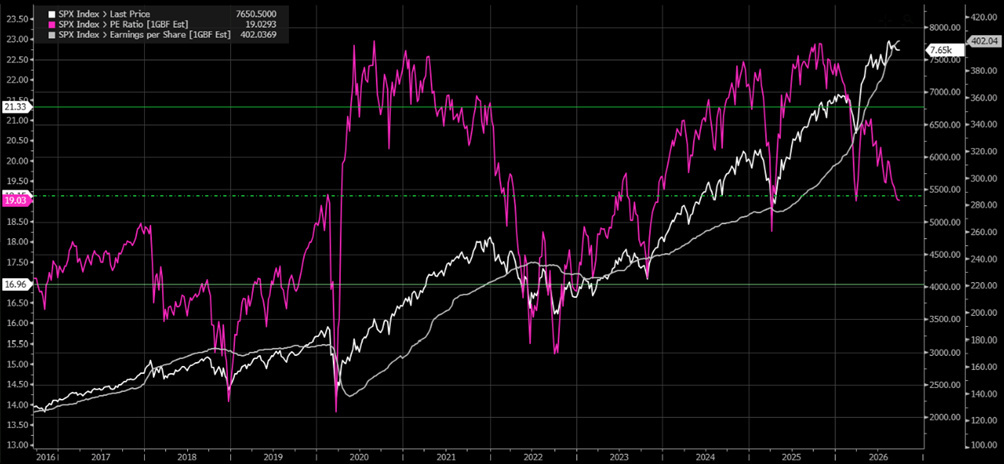
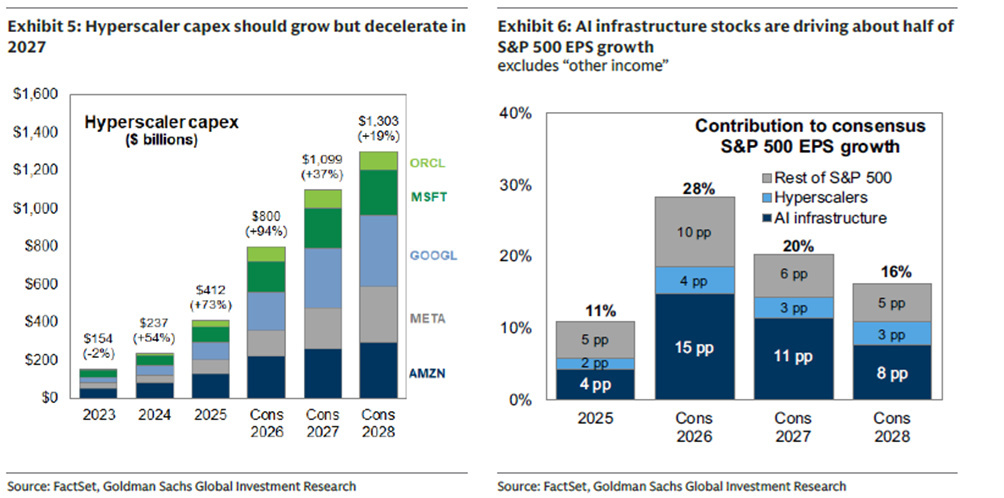
The real issue, if anything, is a different one: we may simply be “earning too much” right now. In other words, part of this profit growth is being temporarily boosted by three factors that are likely to fade over time. The first is the boom in artificial intelligence investment, which alone accounts for nearly half of this year’s earnings growth. The 0 billion being spent by cloud giants is flowing directly into the revenues of companies producing chips, hardware, and energy infrastructure. But as those investments mature, they also bring rising depreciation costs, which gradually eat into profits. So much so that AI is expected to go from adding around eleven percentage points to earnings growth this year to becoming a slight drag by 2028.
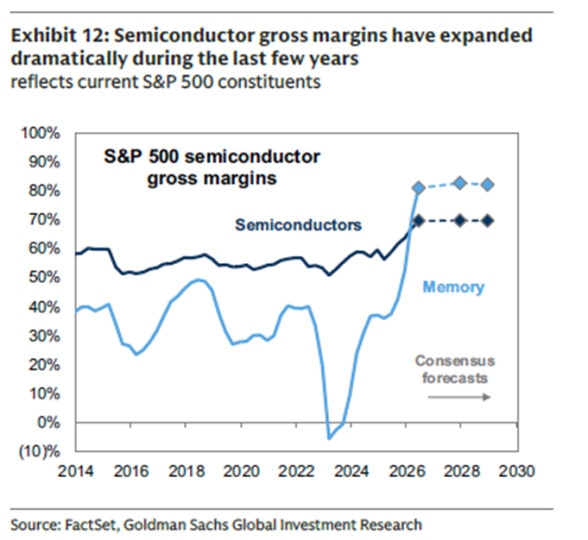
The second factor is semiconductor margins, which are currently at record highs.
Memory chip companies are operating with margins of around 80%, roughly double their historical average. If those margins were to return to more normal levels, earnings for the overall index would fall
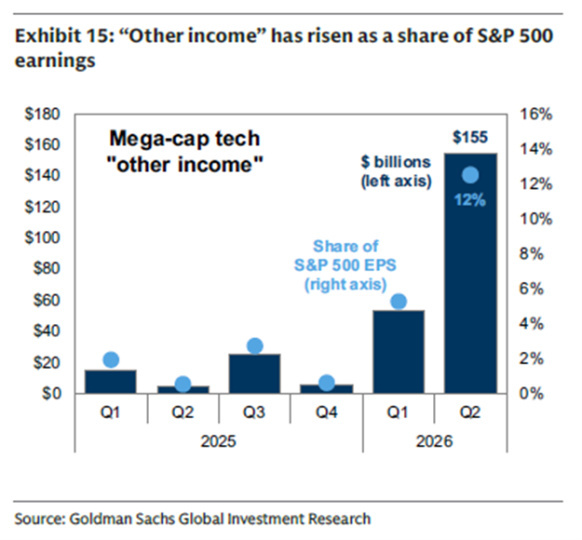
The third factor is one we already know well: the accounting gains recorded by the tech giants on their stakes in private AI companies. These gains amount to roughly 0 billion and account for around 12% of the index’s earnings. But they are largely paper gains — and, crucially, they are not recurring.
The conclusion, then, is a balanced one — and that is exactly why I chose this theme as today’s guiding idea.
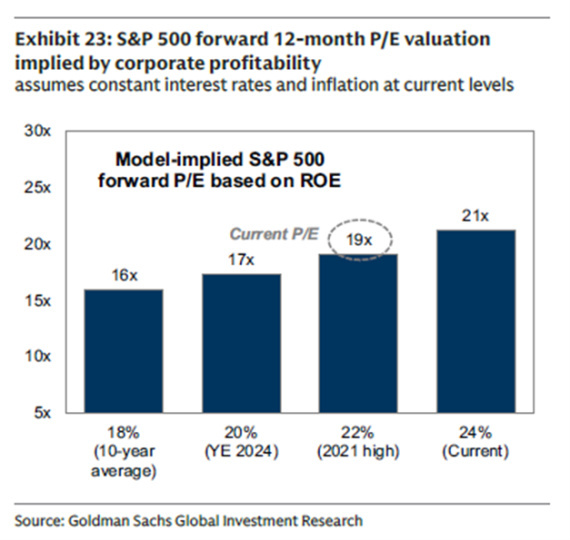
Earnings are likely to slow over the next few years, but not collapse. Current estimates point to growth of around 11% in both 2027 and 2028, with the index potentially reaching 8,700 over the next twelve months. The key point, however, is that this move would be driven by earnings, not by further valuation expansion. And there is one detail I find reassuring: despite record profitability, the market is already trading at a discount to what those profit levels would normally justify. In other words, investors have already priced in part of the normalization. That is the opposite of bubble-like euphoria.
Now let’s bring the two pillars together, because the full picture only emerges when we look at how they interact.
On one side, the Fed is tightening, but cautiously, and interest rates only become a real problem if the economy starts to weaken. On the other, earnings are strong and largely genuine, but they are still running above a sustainable level and are likely to normalize over time. The takeaway is that this is a healthy market, but not a cheap one: supported by real fundamentals, and precisely for that reason, a market where selectivity matters. So what should we take away in terms of method? Two lessons, one from each pillar, that ultimately point in the same direction.
On the Fed: don’t get fixated on a single rate hike or on the 10-year Treasury yield reaching 5%. What matters is not the absolute level of rates, but whether economic growth can hold up. That means the indicators to watch are those tied to the real economy, more than the daily fluctuations in bond yields.
On earnings: don’t judge the market by price alone, but by the quality and durability of the profits behind that price. That means favoring companies with genuine earnings, less dependent on accounting boosts, and being selective within the AI space. And because further upside in equities now depends increasingly on companies actually delivering earnings, rather than on valuations simply expanding, the real question for investors today is not, “How high will rates go?” It is: “How much of this strength — in the economy and in corporate profits — is built to last?” That is where the real game will be played over the coming months.
The contents of this informative message are the result of the free interpretation, evaluation and appreciation of Pharus Asset Management SA and constitute simple food for thought.
Any information and data indicated have a purely informative purpose and do not in any way represent an investment advisory service: the resulting operational decisions are to be considered taken by the user in full autonomy and at his own exclusive risk.
Pharus Asset Management SA dedicates the utmost attention and precision to the information contained in this message; nevertheless, no liability shall be accepted for errors, omissions, inaccuracies or manipulations by third parties on what is materially processed capable of affecting the correctness of the information provided and the reliability of the same, as well as for any result obtained using the said information.
It is not permitted to copy, alter, distribute, publish or use these contents on other sites for commercial use without the specific authorization of Pharus Asset Management SA.