Wall Street: A Tug-of-War Between Earnings and Interest Rates—Who Will Come Out on Top for the S&P 500?
15 October 2026 _ News

This year, a battle has been raging on the U.S. markets between two opposing forces, and the latest figures clearly show who is winning. On the one hand, the cost of borrowing has risen to levels not seen in over twenty years, with the 10-year yield climbing from 4.2% at the end of 2025 to about 5.3%.
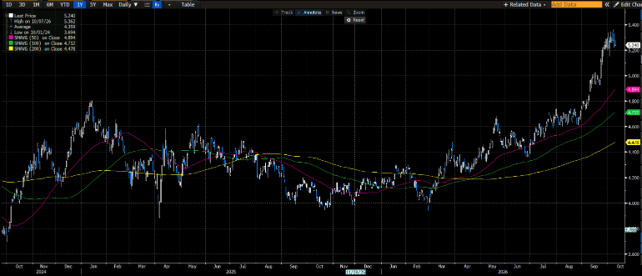
On the other hand, corporate profits are rising. The result? Last Tuesday, the S&P 500 and the Nasdaq closed at new all-time highs.
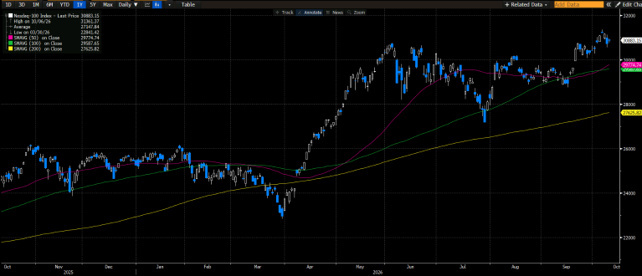
And now that the new earnings season is kicking off, it’s this very battle that will determine the rest of the year.
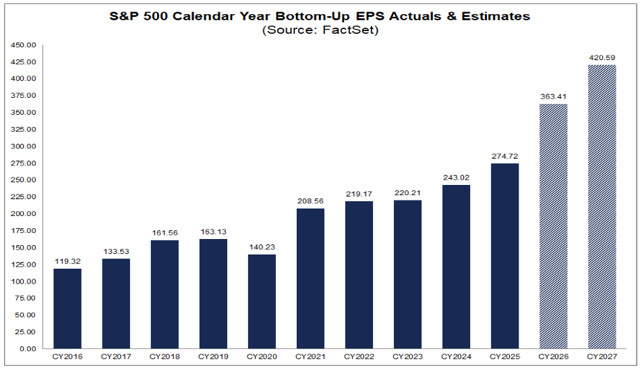
Imagine a tug-of-war. On one side are interest rates, which are pulling valuations and thus prices down. On the other side are earnings, which are pushing them up. If we break down the S&P 500’s year-to-date return about 15%, including dividends into its components, the picture becomes crystal clear. Rising earnings expectations contributed 29 percentage points. The contraction in multiples that is, the fact that investors are now paying less for each dollar of earnings subtracted nearly 15 percentage points. Dividends added one percentage point.
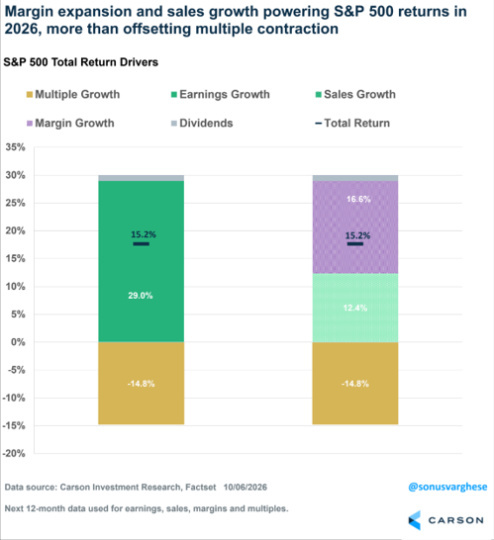
In other words, interest rates behaved exactly as expected, so much so that the price-to-earnings ratio fell from 22 to just over 19 times, but earnings grew at a faster pace. And taking a broader view reinforces this message: from 2020 to the present, the rise in multiples has contributed just 5 percentage points to returns, compared to the 137 percentage points driven by earnings. We are not facing a market inflated by euphoria, but one supported by profits. It is a healthier foundation, but one that holds true only under one specific condition: earnings must continue to come in and not disappoint.
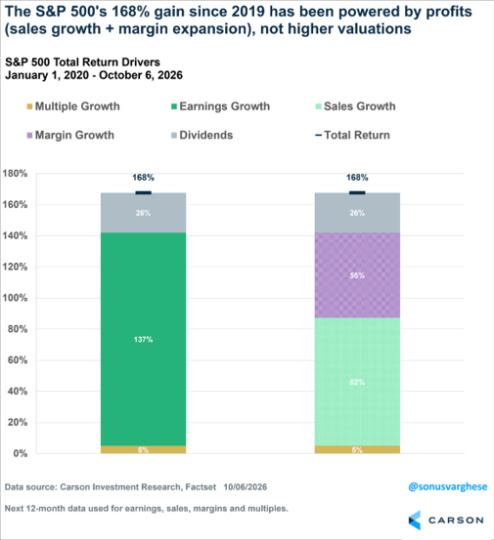
And where does this strength come from? Not so much from revenue which is growing at a rate of more than 12% but rather from margins. The expected profit margin for companies in the index has reached a record 17%, and in the first nine months of the year, it rose more than it did in the previous three years combined.
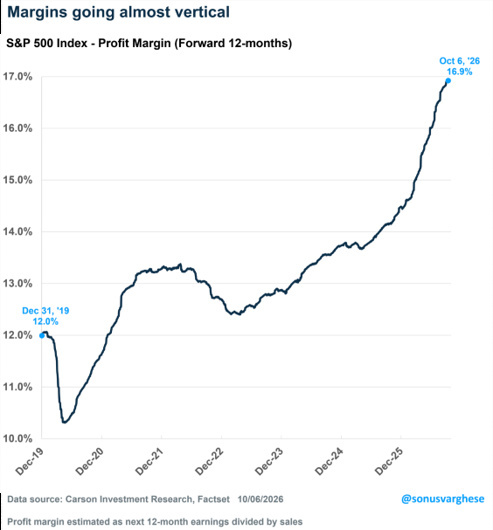
Here, however, we must also look at the other side of the coin. Widening margins mean, in part, that companies are able to raise prices faster than their costs. This is great for profits, but not so great for inflation. And this is precisely where the Fed comes in: the very force that is propping up the stock markets is keeping inflation high and thus interest rates high as well. Some economists even argue that, for the Fed’s rate hikes to truly take effect, the stock markets might need to cool off. It’s a cycle worth keeping an eye on, but one that is clearly grounded in and stems from a single factor: earnings growth.
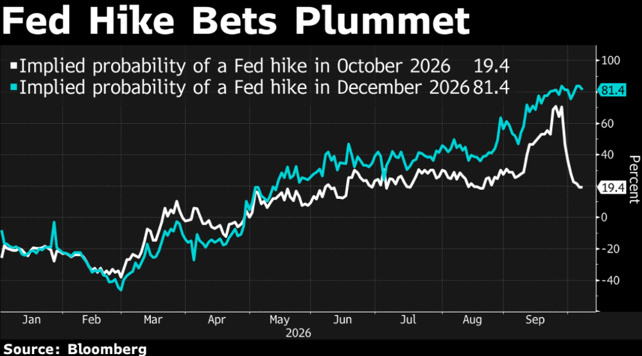
Meanwhile, the Fed has reaffirmed its stance. The minutes from the September meeting describe a resilient economy, a labor market close to full employment, and inflation that remains too high. Most members believe another rate hike is likely by the end of the year, and some have raised their estimate of the “neutral” rate that is, the level that neither slows nor stimulates the economy. The market reacted calmly. Weaker-than-expected September employment data reduced the likelihood of a rate hike in late October, just before the midterm elections, and the prevailing expectation is for a hike in December.
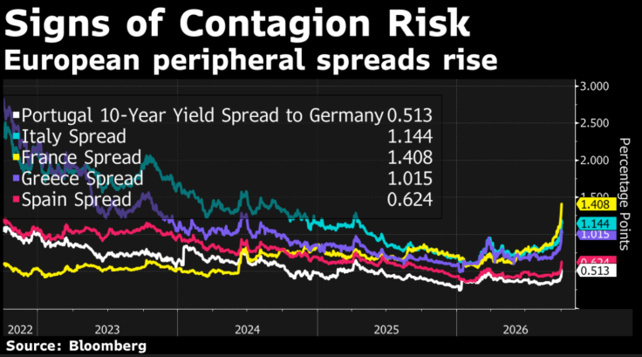
On interest rates, Ed Yardeni offers a useful analysis, a sort of spectrum ranging from good to bad. On the positive side, there’s an economy growing faster than expected and a higher neutral rate. Driving this are the enormous demand for capital in artificial intelligence, a generation of baby boomers who are shifting from saving to spending, and rising productivity thanks to AI. In the middle lies the energy shock linked to the Middle East. At the opposite extreme is the debt crisis: the so-called “bond vigilantes” investors who punish spendthrift governments are pushing yields above economic growth and triggering a spiral of higher interest rates, higher deficits, more debt, and even higher yields. According to Yardeni, the United States remains on the safe side, with yields below nominal growth of more than 6%. France, on the other hand, is edging toward the danger zone, where the 10-year yield has surpassed nominal growth amid high debt, weak growth, and political gridlock. This is not a prophecy of crisis, but a warning for those investing in Europe, because the risk is contagion.
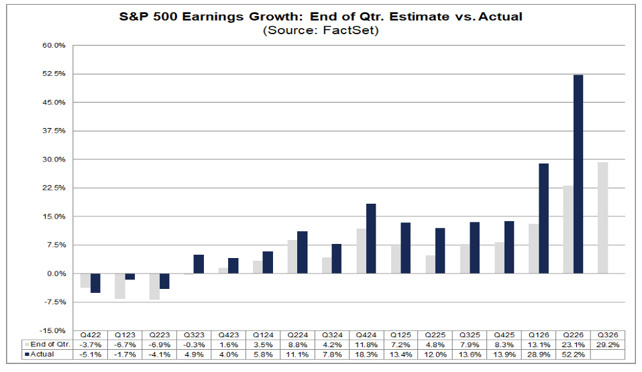
So let’s get to the main event. Tomorrow, Tuesday, October 13, the quarterly earnings season kicks off with the major banks, starting with JPMorgan. The outlook is impressive. Usually, over the course of a quarter, analysts revise their estimates downward. This time, however, they’ve raised them, bringing the expected third-quarter earnings growth from 27.6% to 30%, one of the largest upward revisions in the last thirty years.
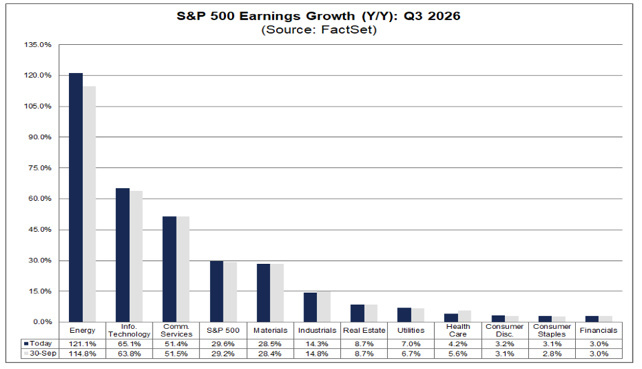
All eleven sectors of the index are expected to show growth in both revenue and earnings, something that has happened only once in the past twenty-five years in 2021.
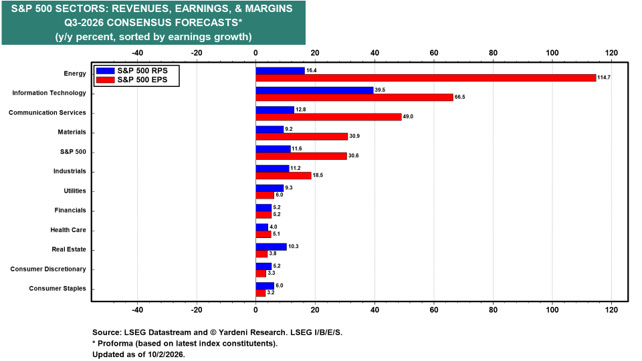
The energy sector leads the way, with profits more than doubling thanks to oil, but this strength also extends to small and medium-sized companies. For banks, the signs are encouraging. Loans to businesses are growing by nearly 10% annually. Provisions for credit losses have remained stable for two years, a sign that credit quality is holding up. Bond and stock issuances have reached a record .1 trillion, a boon for investment banking. Yet this year, bank stocks have lagged behind, held back by higher short-term interest rates and a less robust IPO market.
And this is where balance is needed. Precisely because expectations have risen so much, the bar is high—very high. With the market trading at over 19 times earnings, any company that disappoints will be punished, and simply beating estimates won’t be enough: the quality of the forecasts will matter. Added to this is the situation in the Middle East, where Houthi attacks on Saudi Arabia are keeping oil tensions high, and a market that remains largely unengaged outside the tech sector, where several stocks are nearing 20% declines from their highs, even as the overall picture is slowly improving.
In short, right now the game is being played on one side of the tightrope. Interest rates have already had their effect on valuations, and some of the risk is already priced in. Now it’s up to earnings to keep the momentum going. In the coming weeks, rather than focusing on quarterly numbers, I’d look at three things: whether margins hold up, companies’ guidance for 2027, and the ability of growth to extend beyond the usual names. As long as earnings outpace interest rates, the market can withstand even a 10-year yield above 5%. The day earnings momentum starts to wane that would be the real signal not to be ignored.
The contents of this informative message are the result of the free interpretation, evaluation and appreciation of Pharus Asset Management SA and constitute simple food for thought.
Any information and data indicated have a purely informative purpose and do not in any way represent an investment advisory service: the resulting operational decisions are to be considered taken by the user in full autonomy and at his own exclusive risk.
Pharus Asset Management SA dedicates the utmost attention and precision to the information contained in this message; nevertheless, no liability shall be accepted for errors, omissions, inaccuracies or manipulations by third parties on what is materially processed capable of affecting the correctness of the information provided and the reliability of the same, as well as for any result obtained using the said information.
It is not permitted to copy, alter, distribute, publish or use these contents on other sites for commercial use without the specific authorization of Pharus Asset Management SA.