The risk the market has stopped fearing
23 July 2026 _ News

This week, I’d like to begin with an episode that, in my view, captures the state of the market better than any indicator.
On Thursday morning, Taiwan Semiconductor—the world’s largest chip foundry and the company that physically manufactures the processors used by Nvidia, Apple, and almost the entire artificial intelligence industry—reported record quarterly revenue of .2 billion. It raised its full-year revenue forecast. It increased its investment plans. The results were, objectively, exceptional.
Yet the stock fell. And the entire semiconductor sector fell with it.
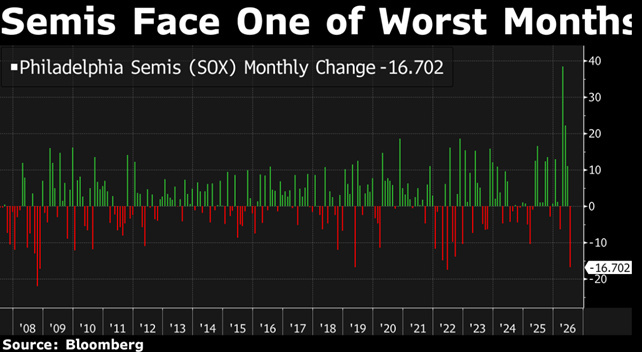
Now, when a company reports record-breaking numbers and the market responds by selling, the message is not about the company. It is about expectations. It means that prices had already factored in all that perfection, and perhaps even more. The exact same thing had happened just a few days earlier in Europe with ASML: a different company, but exceptional results and an identical negative market reaction.
That is the clearest picture of this market phase: doing well is no longer enough. Companies have to outperform a bar that keeps rising every week. IBM followed the same script, but with the opposite and far more painful outcome. On Tuesday, the company surprised everyone by releasing its results eight days early—and when a company brings forward its earnings report, it is rarely to deliver good news.
Earnings came in below expectations, revenue disappointed, and the stock fell almost 25% in what was the worst trading day in IBM’s history.
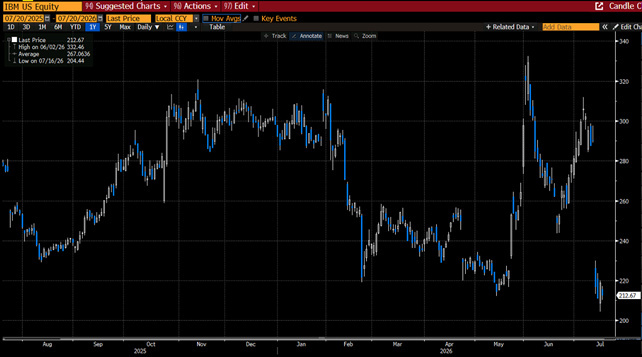
Its CEO was candid: “We stumbled this quarter.” But for investors, the most interesting part is not the number itself. It is the explanation behind it.
IBM said its clients are reallocating their budgets. They are buying servers, storage, and memory now, bringing purchases forward to protect themselves against expected price increases. And every dollar redirected toward hardware is a dollar taken away from software and consulting, the core of IBM’s business. This is scarcity psychology applied to enterprise technology: panic buying reduces supply, prices rise, and that triggers even more panic buying. For companies selling memory and hardware, this is a windfall today.
But there is a catch: a purchase brought forward today often means a sale lost tomorrow. Total profits over the next few years may not change; what changes is their distribution over time. And a market that thinks quarter by quarter risks mistaking demand being brought forward for genuine acceleration. This is exactly the same dynamic that several sectors experienced after Covid, when economic activity and consumption restarted. Take the alcoholic beverages sector, for example, where many stocks are still down by around 50% after five years of persistent declines. That experience could help us frame the risks and potential implications for our portfolios.
Let us now turn to the banks, because earnings season has officially begun and, on the surface, the numbers were impressive.
JPMorgan beat revenue estimates by 13%, with profits rising 41%. Goldman Sachs, Morgan Stanley, and BlackRock all came in above expectations.
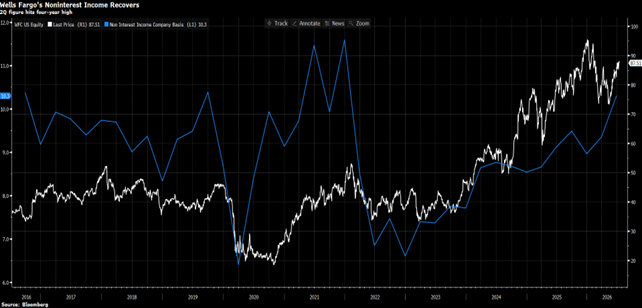
The financial sector, largely overlooked throughout the first half of the year, has returned to centre stage. But our job is to read the footnotes, and that is where the story becomes more nuanced. First, JPMorgan’s billion in profits included .6 billion in one-off capital gains. Excluding those, profit growth falls to a more modest 13%. Second, and more importantly, these exceptional results did not come from traditional banking. They came from the trading floor. JPMorgan’s equity trading revenue surged by 86%, Citi’s rose by 45%, and investment banking fees increased by 30%, helped by the quarter’s volatility, strong retail speculative activity, and the SpaceX IPO.
Net interest income—the ordinary business of lending money—grew at a much slower pace. Trading revenues are volatile by nature: they may be there in one quarter and disappear in the next.
The genuinely positive news lies elsewhere: credit portfolios remain healthy. Credit card delinquencies are stable or declining, while Wells Fargo’s credit losses fell. The American consumer, widely expected to be under pressure, passed the second-quarter test. And speaking of consumers, this week also brought a highly significant macroeconomic development: inflation finally surprised to the downside. The June CPI fell by 0.4% month on month, the largest decline since April 2020, bringing the annual inflation rate down from 4.2% to 3.5%. Core inflation fell to 2.6%.
The main driver was oil. Petrol prices dropped by almost 10% during the month, reflecting, with the usual statistical lag, the fall in crude oil prices from 0 to just above . Producer prices also declined.
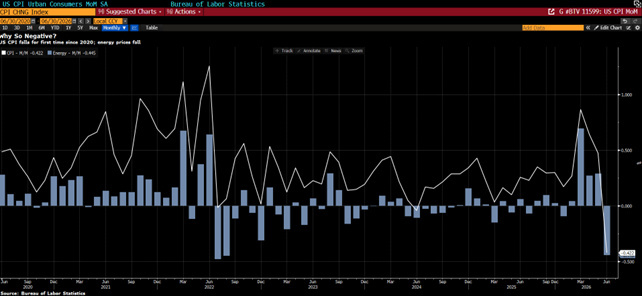
The market cheered the news, and the probability of a rate hike in July effectively disappeared.
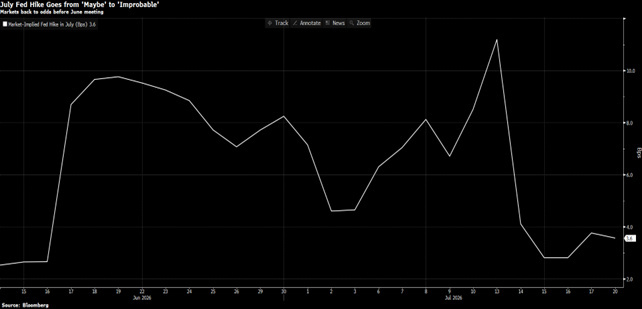
But intellectual honesty is essential here: most of this decline came from energy. More than half of the categories in the core basket are still running above 3%. More importantly, the oil price that helped produce this inflation reading has started rising again. Peace talks with Iran have collapsed, fighting has resumed, and the Strait of Hormuz has been blocked. June’s data describes a world that, unfortunately, had already changed by July. And this brings us to the issue that has made me think the most this week: the market’s reaction to all of this—or rather, its lack of reaction. The war has resumed, the Strait of Hormuz is blocked, and Brent crude is trading at around a barrel—high, but without any sign of panic. The VIX, the market’s fear index, remains low.
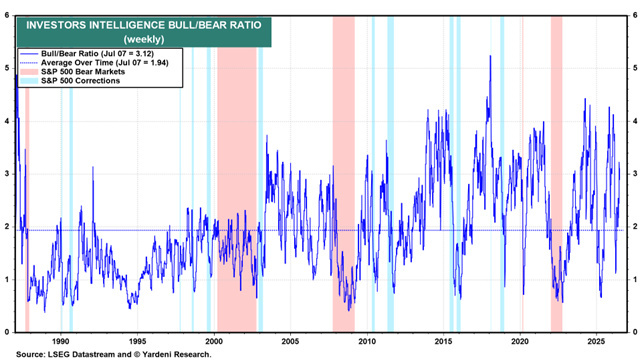
Investor sentiment has climbed to extreme levels. The bull-to-bear ratio is above 3, well above its historical average. Bank of America’s survey of global fund managers shows exceptionally low cash levels and record confidence in a scenario with no economic slowdown—enough to trigger the bank’s contrarian sell signal.
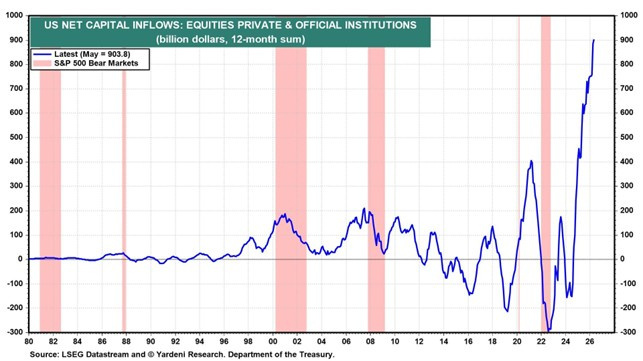
Foreign investors have purchased more than 0 billion worth of US equities over the past twelve months, an all-time record. Historically, large foreign inflows tend to cluster toward the end of bull markets, not at the beginning. None of this is an immediate sell signal, and I want to be clear about that. But when optimism becomes a unanimous consensus, the market becomes vulnerable not to the bad news it already knows, but to the risks it has stopped considering. Complacency does not cause markets to fall. It does, however, make them more fragile when something unexpected happens.
That said, it would be wrong to conclude without acknowledging the strength of the fundamentals, because it is real and deserves to be respected.
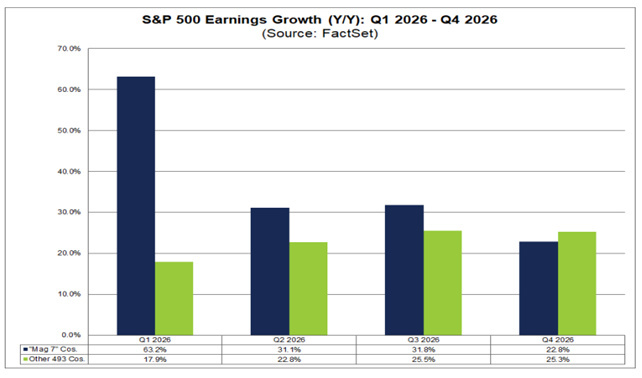
The US economy continues to surprise to the upside. Retail sales, excluding petrol, rose by 0.7% in June. Initial jobless claims are at a ten-week low. Manufacturing indices in New York and Philadelphia are at their highest levels since 2022. And the main engine is still running. The four hyperscale giants are expected to invest around 0 billion in artificial intelligence infrastructure this year, 75% more than last year. That spending, which accounts for almost half of recent US GDP growth, becomes revenue for hundreds of other companies. This tailwind has so far absorbed every headwind. The right question is not whether it is real. It is how long it can continue to blow more strongly than everything else.
So, what should investors do?
First, respect the rotation already under way. Financials and other sectors that had been left behind are now attracting flows moving out of technology. A well-balanced portfolio should reflect this broadening of the market rather than fight it. Second, when it comes to semiconductors and the major winners of the AI boom, after such parabolic moves, the risk-reward no longer favours those chasing performance. TSMC’s results confirm the lesson: when record earnings are no longer enough to push prices higher, the scope for positive surprise has largely been exhausted. Third, maintaining a liquidity reserve remains a relatively inexpensive form of insurance against scenarios that the market is currently choosing not to price in.
Next week, the major technology companies will report their quarterly results. That will be the real test of this earnings season.
The contents of this informative message are the result of the free interpretation, evaluation and appreciation of Pharus Asset Management SA and constitute simple food for thought.
Any information and data indicated have a purely informative purpose and do not in any way represent an investment advisory service: the resulting operational decisions are to be considered taken by the user in full autonomy and at his own exclusive risk.
Pharus Asset Management SA dedicates the utmost attention and precision to the information contained in this message; nevertheless, no liability shall be accepted for errors, omissions, inaccuracies or manipulations by third parties on what is materially processed capable of affecting the correctness of the information provided and the reliability of the same, as well as for any result obtained using the said information.
It is not permitted to copy, alter, distribute, publish or use these contents on other sites for commercial use without the specific authorization of Pharus Asset Management SA.